

Digital infrastructure now consumes more electricity than many industrial sectors, and compute density keeps climbing. AI training clusters, cloud platforms, and always-on enterprise systems demand uninterrupted power, while energy volatility and tightening ESG regulations are forcing organizations and investors to rethink how data center capacity gets built.
Sustainable colocation has emerged as the practical answer to both pressures at once. Instead of constructing private facilities or committing to multi-year hyperscale builds, organizations place infrastructure inside professionally managed, renewable-powered environments designed for efficiency, resilience, and rapid deployment.
This report breaks down what sustainable colocation is, how it performs against private cloud, traditional colocation, and on-premise infrastructure, what the underlying environmental and financial benchmarks look like in 2026, and what investors and enterprises should evaluate before choosing a provider.
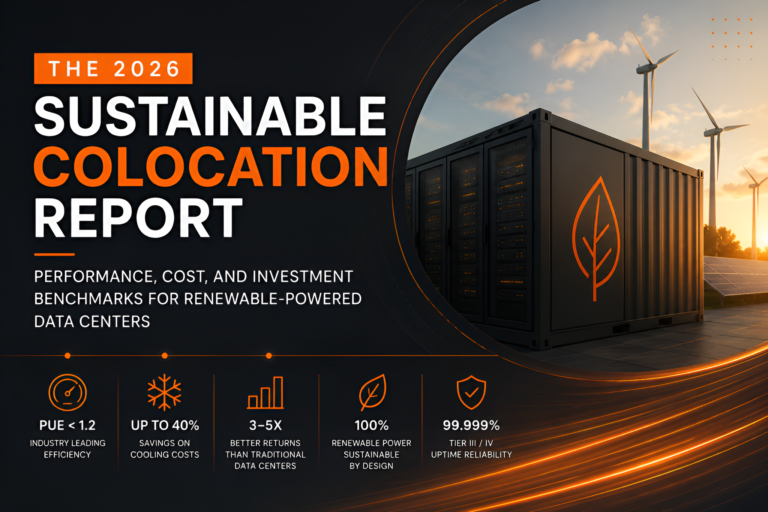
Sustainable Colocation: 2026 Benchmarks at a Glance
As AI workloads and tightening ESG requirements reshape data center demand, this report sets out the core 2026 performance and sustainability benchmarks for colocation infrastructure.
We analyzed deployment timelines, energy efficiency standards, uptime guarantees, and return profiles across renewable-powered colocation facilities, so investors and enterprises can benchmark their infrastructure strategy against current standards.
The main takeaway: Sustainable colocation isn’t just an alternative to traditional builds—it’s becoming the baseline. Energy sourcing, deployment speed, and environmental performance are no longer separate from cost and ROI; they’re now the same conversation. Benchmarking against these standards is the starting point for any infrastructure decision in 2026.
What Are Data Center Colocation Services?
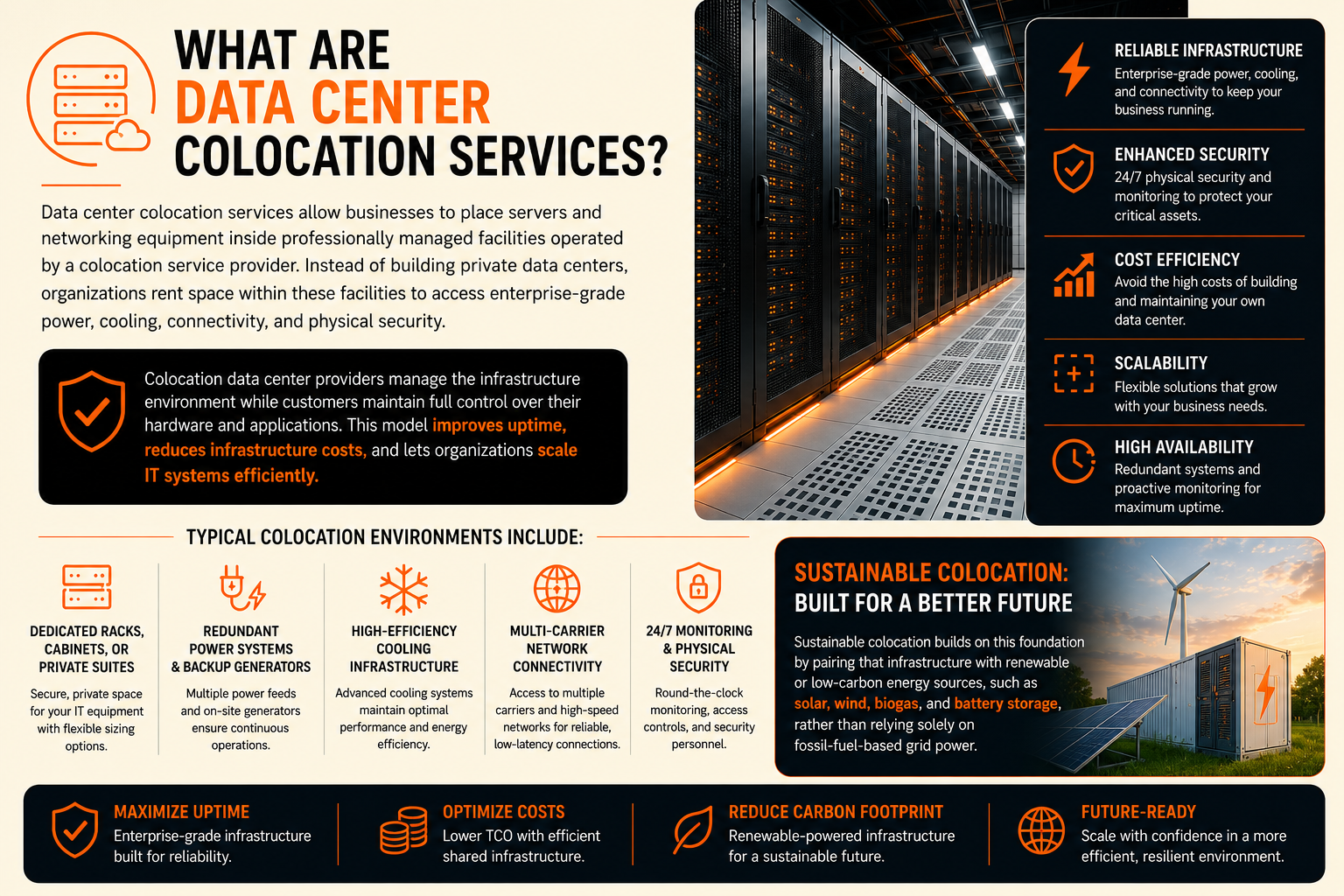
Data center colocation services allow businesses to place servers and networking equipment inside professionally managed facilities operated by a colocation service provider. Instead of building private data centers, organizations rent space within these facilities to access enterprise-grade power, cooling, connectivity, and physical security.
Colocation data center providers manage the infrastructure environment while customers maintain full control over their hardware and applications. This model improves uptime, reduces infrastructure costs, and lets organizations scale IT systems efficiently.
Typical colocation environments include:
- Dedicated racks, cabinets, or private suites
- Redundant power systems and backup generators
- High-efficiency cooling infrastructure
- Multi-carrier network connectivity
- 24/7 monitoring and physical security
Sustainable colocation builds on this foundation by pairing that infrastructure with renewable or low-carbon energy sources, such as solar, wind, biogas, and battery storage, rather than relying
solely on fossil-fuel-based grid power.
Why Sustainability Has Become a Core Infrastructure Requirement
Sustainability is no longer a nice-to-have line item. It directly influences cost control, resilience, compliance, and long-term scalability, and colocation models now play a central role in reducing environmental impact while maintaining performance.
Conventional data centers concentrate large power demand in single locations. Grid upgrades often take years, and during peak demand, facilities fall back on carbon-intensive backup generation while cooling systems add further emissions. Centralized builds also carry extended construction timelines, which increase embodied carbon from materials and delay efficiency gains.
Sustainable colocation changes this pattern by distributing capacity closer to energy sources and end users. Solar generation paired with battery storage supplies energy at the site level, reducing reliance on fossil-heavy grids and lowering transmission-related losses. Many sustainable colocation facilities operate behind the meter, generating and consuming power locally, which stabilizes supply during grid disruptions and reduces cumulative emissions across long-duration compute workloads.
Key Benchmarks: What “Sustainable Colocation” Means in Practice
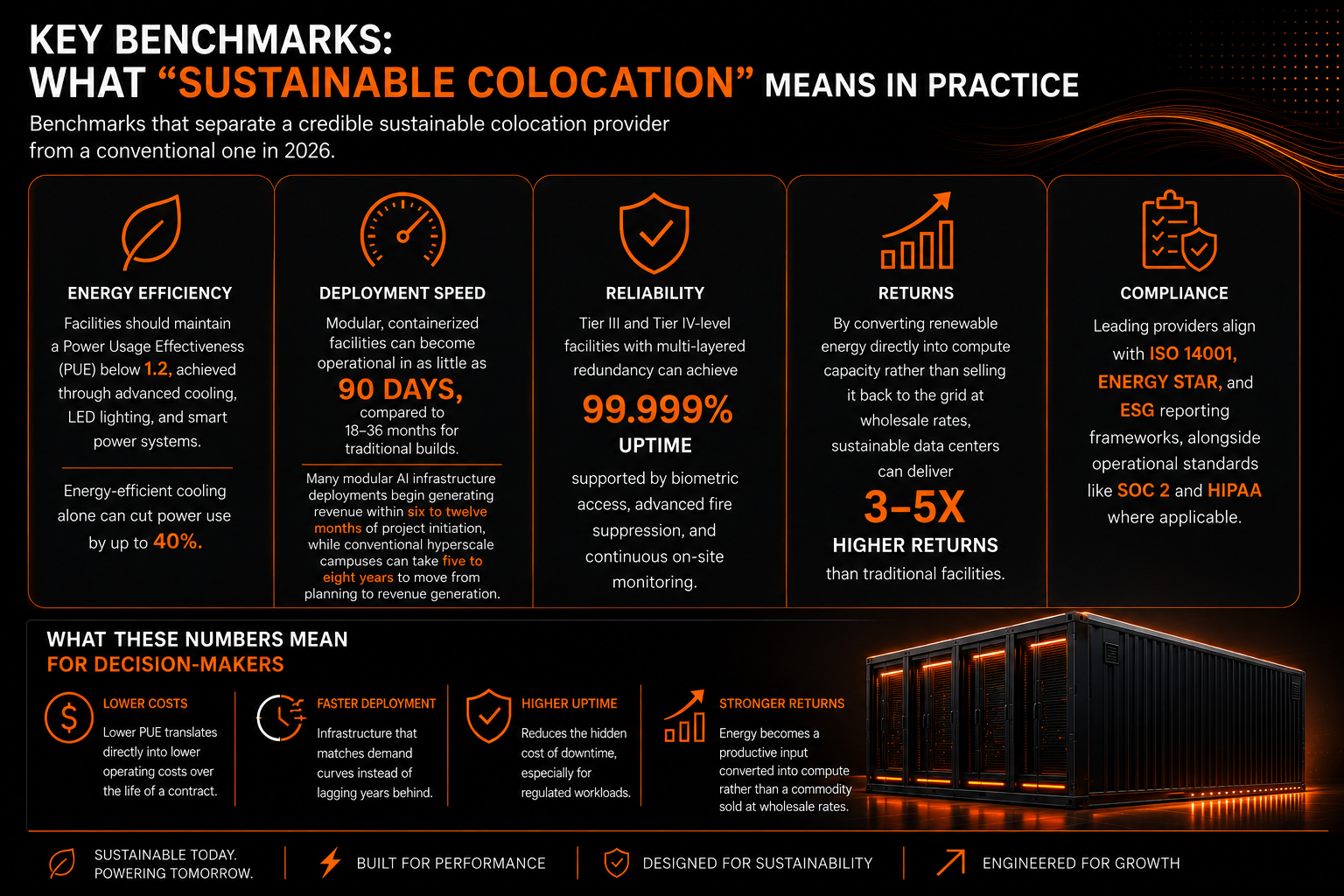
Before comparing infrastructure models in depth, here are the benchmarks that separate a credible sustainable colocation provider from a conventional one in 2026.
Energy efficiency: Facilities should maintain a Power Usage Effectiveness (PUE) below 1.2, achieved through advanced cooling, LED lighting, and smart power systems. Energy-efficient cooling alone can cut power use by up to 40%.
Deployment speed: Modular, containerized facilities can become operational in as little as 90 days, compared to 18-36 months for traditional builds. Many modular AI infrastructure deployments begin generating revenue within six to twelve months of project initiation, while conventional hyperscale campuses can take five to eight years to move from planning to revenue generation.
Reliability: Tier III and Tier IV-level facilities with multi-layered redundancy can achieve 99.999% uptime, supported by biometric access, advanced fire suppression, and continuous on-site monitoring.
Returns: By converting renewable energy directly into compute capacity rather than selling it back to the grid at wholesale rates, sustainable data centers can deliver returns three to five times higher than traditional facilities.
Compliance: Leading providers align with ISO 14001, ENERGY STAR, and ESG reporting frameworks, alongside operational standards like SOC 2 and HIPAA, where applicable.
Lower PUE translates directly into lower operating costs over the life of a contract. Faster deployment means infrastructure that matches demand curves instead of lagging years behind them. Higher uptime reduces the hidden cost of downtime, especially for regulated workloads. And for investors, the revenue model itself changes: energy becomes a productive input converted into compute rather than a commodity sold at wholesale rates.
Ready to evaluate your infrastructure against these benchmarks? Talk to a Flux Core specialist
What These Numbers Mean for Decision-Makers
Lower PUE translates directly into lower operating costs over the life of a contract. Faster deployment means infrastructure that matches demand curves instead of lagging years behind them. Higher uptime reduces the hidden cost of downtime, especially for regulated workloads. And for investors, the revenue model itself changes: energy becomes a productive input converted into compute rather than a commodity sold at wholesale rates.
How Sustainable Colocation Reduces Environmental Impact
Renewable-powered colocation centers maintain consistent energy performance across extended, high-density workloads. Solar generation paired with battery storage supports long training cycles and high-density compute without the volatility associated with grid dependence. Key sustainability benefits include:
- Carbon emissions decline through reduced reliance on fossil-based grid power
- Energy costs become more predictable over long operating periods
- Uptime remains stable during regional grid stress events
By aligning compute with clean energy, sustainable colocation supports both environmental goals and operational reliability at the same time. This model is explored further in how sustainable colocation reduces the environmental footprint of digital infrastructure.
Why Decentralization Matters
Decentralized colocation distributes infrastructure across multiple locations operating closer to users and energy resources. This reduces transmission losses, network congestion, and localized environmental stress. Power draw, cooling demand, and land use stay balanced across regions instead of concentrating at a single site, which supports resilience while lowering the localized environmental burden of any one facility.
Modular Design and Long-Term Environmental Efficiency
Modular data center design improves environmental efficiency through standardization. Each module integrates power, cooling, security, and monitoring within a compact footprint and is factory-built rather than custom-constructed onsite. Standardized modules reduce material waste, and capacity scales incrementally, aligning infrastructure growth with actual demand instead of oversized builds designed for projected peaks that may never arrive.
Shorter deployment cycles compound this benefit. Facilities activate in months instead of years, so energy-efficient infrastructure replaces older systems faster, lowering cumulative environmental impact across the asset’s lifecycle.
The Structural Sustainability Advantages of Shared Infrastructure
Beyond renewable power sourcing, colocation itself carries structural sustainability advantages over private, single-tenant data centers, advantages that come from scale and shared infrastructure rather than any single technology.
Shared systems reduce duplication. One cooling system serves multiple tenants. One security perimeter replaces dozens of separate ones. One optimized power architecture supports many workloads at once. This consolidation reduces raw material usage during construction and lowers ongoing energy consumption, because fewer facilities are required to support the same total compute demand.
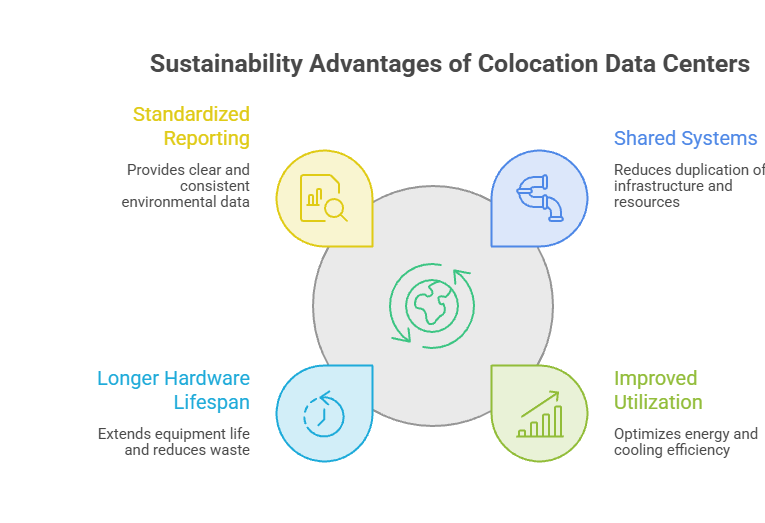
Utilization improves efficiency. Private data centers often run below optimal capacity, with cooling systems operating continuously and backup power consuming resources even while idle. Colocation facilities address this imbalance because infrastructure scales with aggregate demand across tenants, and power and cooling systems align more closely with real usage patterns. Lower PUE means more energy goes toward computing instead of overhead.
Hardware lasts longer. Private environments often replace equipment prematurely due to heat stress or power instability, increasing disposal rates. Colocation facilities maintain more stable temperature and power conditions, extending equipment lifespan and reducing electronic waste across the supply chain.
Reporting becomes operational, not aspirational. Environmental reporting requirements continue expanding, and organizations must document energy usage, efficiency, and emissions trends. Colocation providers supply standardized reporting and real-time monitoring, giving customers visibility into consumption patterns without internal facility audits.
A closer look at the sustainability benefits of colocation data centers breaks down how each of these factors compounds at scale.
Sustainable Colocation vs. Cloud vs. On-Premise Infrastructure
Organizations evaluating infrastructure options often compare colocation, cloud hosting, and traditional on-premise data centers. Each model carries distinct tradeoffs.
| Infrastructure Model | Key Benefits | Limitations |
| Colocation | Full control of hardware with enterprise infrastructure and renewable energy access | Requires hardware ownership |
| Cloud | Rapid scalability and flexible deployment | Higher long-term operating costs |
| On-Premise | Complete ownership and internal control | High capital investment and maintenance |
Many organizations adopt hybrid IT strategies that combine cloud services with colocation infrastructure for greater flexibility and cost optimization. Colocation still requires the organization to manage its own equipment, including updates, patches, configuration, and hardware repairs, which is why it is often paired with managed services or remote-hands support from the provider.
Colocation vs. Private Cloud: Nine Differences That Matter for Investors
For investors evaluating infrastructure for AI and enterprise compute, the choice between private cloud and colocation has direct implications for capital efficiency, deployment speed, and long-term risk exposure.
- Hardware ownership structure. Private cloud requires full ownership of both computing equipment and facility infrastructure, servers, networking, cooling, buildings, and electrical systems. With colocation, organizations own their hardware while leasing space in an existing facility, and the provider operates power, cooling, and security.
- Capital investment requirements. Private cloud facilities require substantial upfront investment in land, construction, and power upgrades before any revenue is generated. Colocation providers already operate the facility, so companies simply deploy hardware into available rack space, shifting spend from large capital expenditure to predictable operating costs.
- Deployment speed and revenue timing. Private cloud projects frequently require multiple years for construction, permitting, and grid interconnection. Colocation facilities typically enable deployment within weeks, accelerating revenue generation and shortening payback cycles.
- Power infrastructure responsibility. Private cloud operators must secure their own utility connections, redundancy systems, and backup generation, and delays in grid upgrades can stall projects. Colocation services come with built-in redundant power feeds, backup generators, battery systems, and advanced cooling for high-density GPU racks.
- Scalability model. Private cloud scales through additional construction phases, each requiring new capital and development time. Colocation enables incremental scaling, adding racks, cages, or suites within existing facilities as demand grows.
- Operational risk allocation. Private cloud ownership concentrates operational risk, facility failures, downtime, and compliance issues with the investor. Colocation providers distribute this risk through professionally managed environments with enterprise-grade resilience and strict service-level agreements.
- Operational complexity. Running a private cloud requires specialized teams managing cooling, power distribution, physical security, and compliance. Colocation providers manage the building infrastructure and environmental systems, freeing internal teams to focus on compute performance.
- Geographic expansion flexibility. Private cloud facilities are tied to a single location, and entering new markets requires acquiring land and building new infrastructure. Colocation providers operate across multiple regions, letting hardware deployments distribute across markets with minimal infrastructure investment.
- Long-term strategic value. Private cloud offers complete customization and facility-level control but exposes investors to large capital commitments and long development cycles. Colocation balances control and flexibility: investors keep ownership of high-value compute assets while outsourcing facility infrastructure, aligning well with AI growth, high-density GPU deployments, and modular expansion.
| Factor | Private Cloud | Colocation Data Centers |
| Capital Investment | Extremely high upfront CapEx | Lower initial investment |
| Deployment Timeline | Often several years | Weeks to months |
| Infrastructure Ownership | Full facility ownership | Hardware ownership only |
| Power & Cooling | Investor-funded | Provider-managed |
| Scalability | Requires new construction | Incremental rack expansion |
| Operational Complexity | High | Reduced |
| Geographic Expansion | Slow | Rapid |
| Time to Revenue | Delayed | Faster |
| Risk Exposure | Concentrated | Shared with provider |
The AI compute market is expanding faster than traditional infrastructure development can support, and this demand surge is pushing investors toward faster, modular infrastructure models that generate revenue earlier in the development cycle. These distinctions are mapped out in full in colocation vs. private cloud: 9 critical differences for investors.
Exploring AI infrastructure investment opportunities? Connect with the Flux Core investment team
Containerized Data Centers vs. Colocation: Which Model Offers Better Returns?
A related question for infrastructure investors is how containerized, modular data center models compare to traditional colocation facilities when it comes to long-term returns.
The capital structure of traditional colocation. Colocation data centers operate on a shared infrastructure model where enterprise customers lease cabinets or dedicated suites while the operator provides power, cooling, and connectivity. These facilities typically generate predictable recurring revenue through long-term contracts, which have historically made colocation a popular asset class. However, developing new colocation facilities often involves significant capital commitments and extended timelines: securing land, utility interconnections, zoning approvals, and power infrastructure before construction even begins. Large campuses may take years to complete and longer still to reach full utilization.
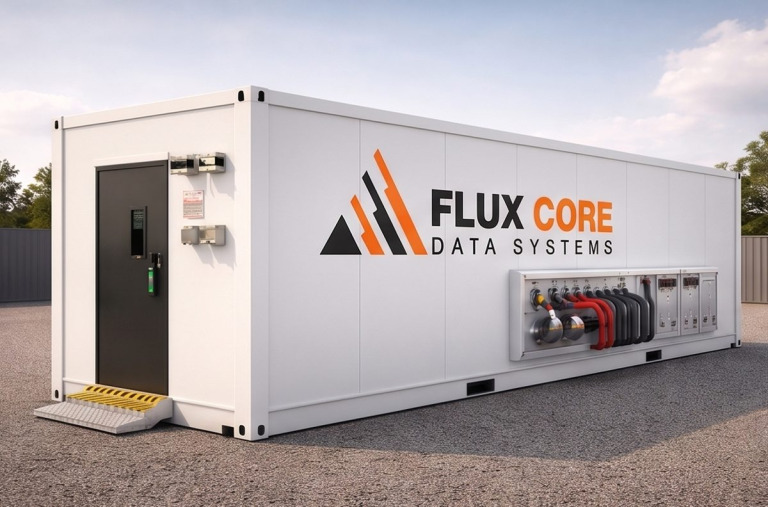
Containerized infrastructure as a scalable alternative. A containerized data center is a modular computing facility built inside a prefabricated enclosure that integrates server racks, cooling systems, power distribution, and monitoring infrastructure. Each unit typically delivers 400 kW to 1 MW of IT capacity and can be deployed within months rather than years, with additional modules installed as demand grows. This changes the traditional investment timeline: instead of allocating large amounts of capital upfront to a campus that may take years to become operational, investors can deploy smaller assets that begin generating revenue much earlier in the project lifecycle.
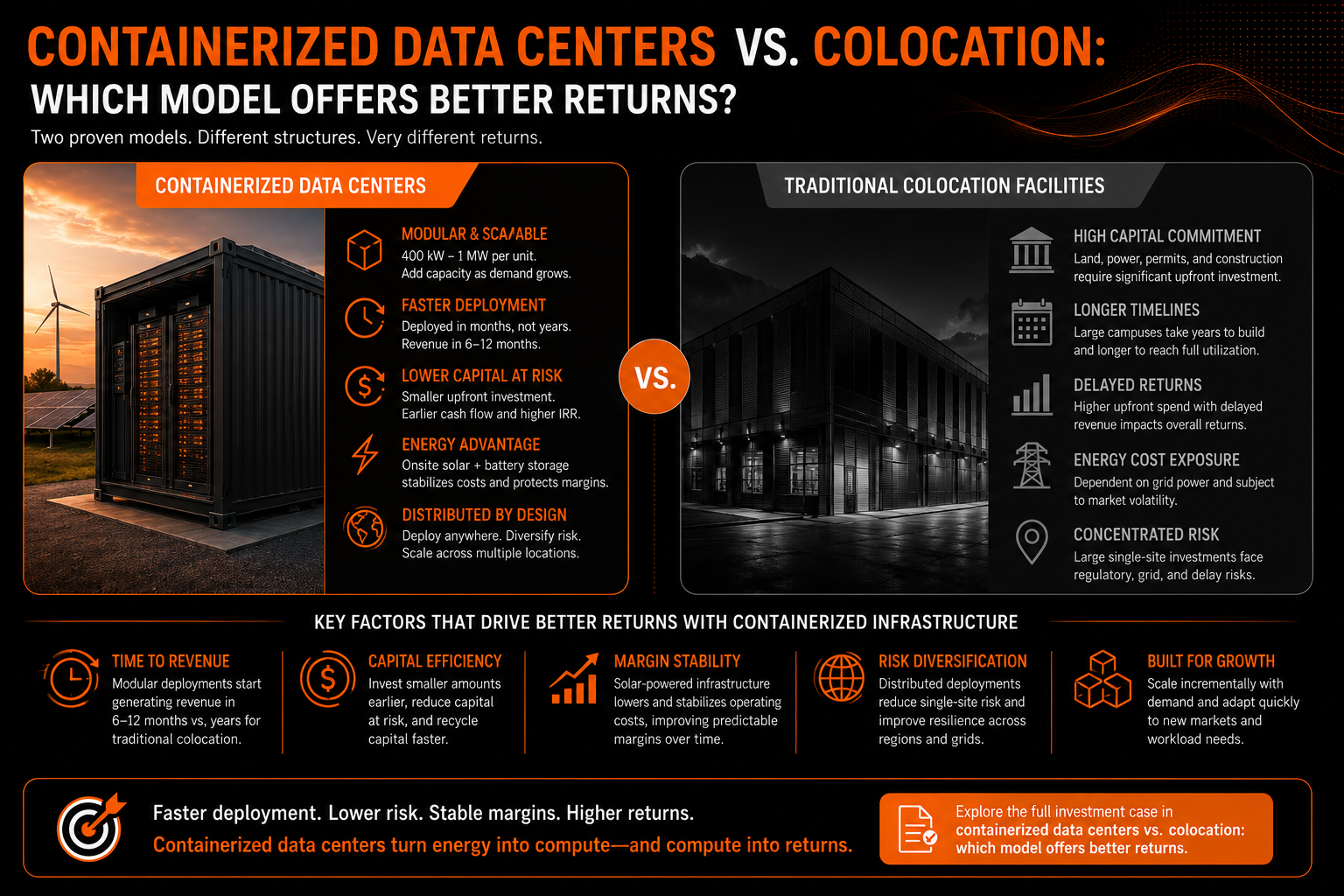
Time to revenue is the deciding factor. Large hyperscale campuses may require years of planning, permitting, and construction before the first workloads deploy, and even after completion, facilities often take additional time to reach full occupancy. Containerized data centers significantly shorten this cycle. Prefabricated modules arrive with integrated power distribution, cooling, and monitoring already installed, and many modular deployments begin generating revenue within six to twelve months of project initiation, improving IRR and enabling faster capital recycling into new projects.
Energy strategy affects margin stability. Energy costs represent the largest operating expense for most data centers, and as AI workloads increase power density, long-term electricity pricing becomes a major factor in investment returns. A solar-powered strategy combining modular infrastructure with onsite renewable generation and battery storage can stabilize operating costs by reducing exposure to electricity market volatility, and behind-the-meter generation may also qualify for tax incentives or energy credits in some regions.
Distributed deployments diversify risk. Large digital infrastructure projects often concentrate substantial capital in a single location, where development delays, regulatory challenges, or grid limitations can significantly impact timelines and returns. Because each containerized module operates as an independent computing unit, capacity can be distributed across multiple locations, reducing single-site risk while enabling geographic diversification and gradual scaling.
The full investment case for each model is covered in containerized data centers vs. colocation: which model offers better returns.
Explore how Flux Core’s modular deployments generate returns faster than traditional builds. Talk to an infrastructure specialist
How Data Center Colocation Services Work
Colocation services provide shared infrastructure environments where businesses install and operate their own servers while the facility operator manages critical systems such as power distribution, cooling, connectivity, and security. A typical deployment includes server racks or cabinets in secure data halls, redundant power distribution units, advanced cooling and environmental monitoring, direct connections to network carriers, and backup generators with disaster recovery infrastructure.
Modular facilities scale from single racks to full suites. With redundant network routes, customizable power configurations, and built-in disaster recovery, colocation infrastructure grows alongside the business while maintaining uptime and security. For organizations evaluating recovery planning specifically, Flux Core’s disaster recovery solutions cover how renewable-powered infrastructure supports business continuity.
Flux Core operates Tier III and Tier IV-level data centers with multi-layered redundancy and 99.999% uptime. Security includes biometric access, advanced fire suppression, and continuous on-site monitoring, all powered by clean energy.
See how Flux Core’s renewable-powered facilities support your workloads. Request an infrastructure overview
How to Choose the Right Sustainable Colocation Provider
Selecting the right colocation provider is essential for long-term infrastructure reliability. Organizations should evaluate:
- Uptime guarantees and redundancy levels
- Energy efficiency and renewable power availability
- Physical and network security measures
- Connectivity to multiple network carriers
- Compliance certifications and operational standards (ISO 14001, ENERGY STAR, SOC 2)
Flux Core meets these benchmarks through renewable-powered infrastructure, transparent sustainability reporting, and high-availability facility design, as a veteran- and minority-owned company with decades of experience in solar, energy storage, and data infrastructure.
Industries That Rely on Sustainable Colocation
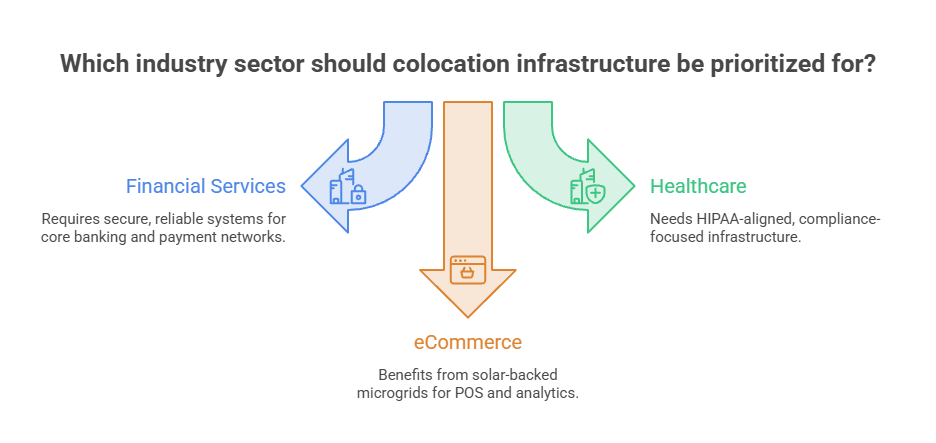
Colocation infrastructure supports a wide range of industries requiring secure, reliable computing environments, including financial services, healthcare, SaaS companies, e-commerce platforms, telecommunications providers, and technology companies.
Flux Core supports several of these sectors directly:
- Financial institutions, with colocation built around microgrid-powered systems for core banking, payment networks, and digital channels
- Healthcare organizations, with HIPAA-aligned, compliance-focused infrastructure
- eCommerce and retail businesses, running POS systems, real-time analytics, and fulfillment infrastructure on dedicated, solar-backed microgrids
These sectors rely on colocation data center providers to maintain secure infrastructure, high uptime, and scalable operations without raising their environmental footprint.
Looking for renewable-powered colocation for your sector? Request an infrastructure assessment
Sustainable Colocation by Renewable Energy Source
The type of renewable energy powering a colocation facility affects both its environmental profile and its regional availability. Flux Core operates across multiple renewable sources:
- Solar-powered data centers, the most widely deployed model across Flux Core’s footprint
- Wind energy-powered data centers, particularly suited to regions with strong wind resources
- Tidal energy-powered data centers, an emerging option for coastal deployments
- Biogas-powered data centers, suited to agricultural and industrial regions with consistent biogas supply
Sustainable Colocation by Location
Flux Core’s modular deployment model allows sustainable colocation facilities to be sited based on renewable energy resources, land availability, and regional compute demand. Current and planned locations include:
- California
- Texas
- Arizona
- Nevada
- Florida
- North Carolina
- Georgia (Atlanta)
Each location pairs strong renewable generation potential, such as Florida’s year-round solar resource, with growing regional digital infrastructure demand.
Seamless Transition to Sustainable Colocation
Migration to sustainable colocation doesn’t need to be disruptive. A structured transition typically includes assessment, planning, and execution phases designed to minimize downtime while optimizing performance and efficiency.
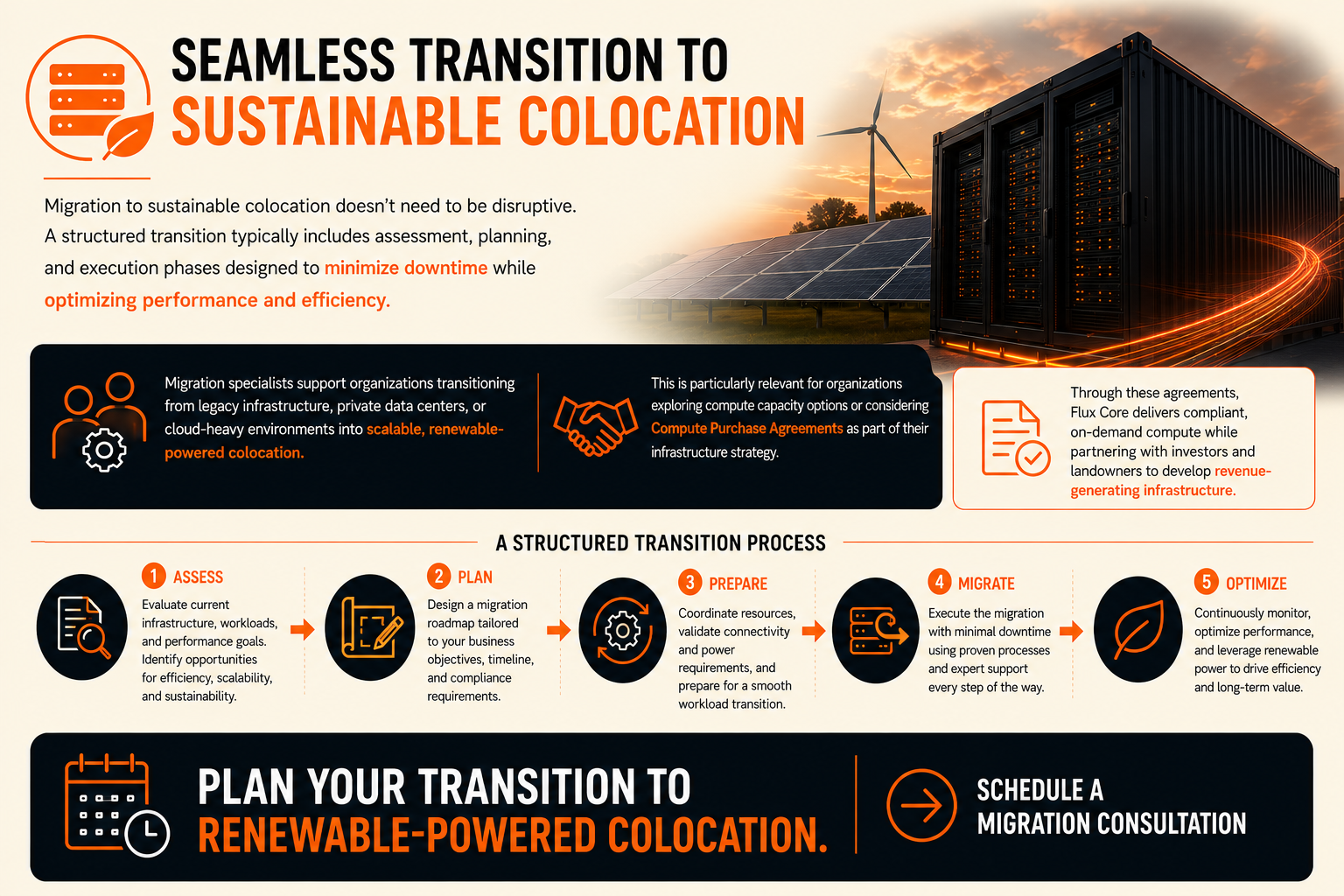
Migration specialists support organizations transitioning from legacy infrastructure, private data centers, or cloud-heavy environments into scalable, renewable-powered colocation. This is particularly relevant for organizations exploring compute capacity options or considering Compute Purchase Agreements as part of their infrastructure strategy. Through these agreements, Flux Core delivers compliant, on-demand compute while partnering with investors and landowners to develop revenue-generating infrastructure.
Plan your transition to renewable-powered colocation. Schedule a migration consultation
Where Flux Core Is Taking Sustainable Colocation Next
Sustainable colocation has moved from a niche sustainability initiative to a core infrastructure strategy. The benchmarks are clear: facilities operating below 1.2 PUE, deploying in 90 days instead of years, and converting renewable energy directly into compute capacity are setting the new standard for what colocation can deliver.
For enterprises, this means lower operating costs and stronger ESG positioning without sacrificing the uptime and security that mission-critical workloads require. For investors, it means a faster path to revenue, improved IRR, and a more flexible capital deployment model than either traditional hyperscale construction or private cloud builds.
Flux Core Data Systems connects renewable energy with digital infrastructure through modular, solar and battery-powered distributed data centers that become operational in as little as 90 days. By turning renewable energy into digital capacity, Flux Core reduces both costs and environmental impact while expanding access to sustainable, high-performance computing across the U.S.
Contact Flux Core to learn more about renewable-powered colocation for your organization.
Frequently Asked Questions
Data center colocation services allow businesses to place servers and networking equipment inside secure data center facilities operated by colocation providers. These facilities provide power, cooling, security, and connectivity while organizations maintain control over their hardware.
Providers like Flux Core operate facilities powered by solar and wind energy, with efficient cooling, advanced monitoring, and verified PUE ratios below 1.2.
A sustainable colocation provider reduces environmental footprint, cuts long-term energy costs, and supports ESG compliance, while still meeting uptime and reliability standards expected of enterprise infrastructure.
Businesses in finance, healthcare, e-commerce, and technology benefit most, as these sectors combine high compute demand with strict uptime, security, and compliance requirements.
Colocation generally offers lower upfront capital requirements, faster deployment, and shared operational risk compared to private cloud, while still allowing investors to retain ownership of their compute hardware.
Containerized infrastructure can shorten the time to revenue significantly, often six to twelve months versus years for hyperscale builds, which improves IRR and allows faster capital recycling. Traditional colocation still offers predictable recurring revenue through long-term contracts, so the better fit depends on an investor’s timeline and risk tolerance.
Pricing typically depends on rack space, power consumption, bandwidth requirements, and facility location. Renewable energy sourcing can also improve long-term cost predictability compared to grid-dependent facilities.
A migration team conducts a full infrastructure assessment, creates a tailored transition plan, and ensures smooth deployment to the new renewable-powered facility with minimal downtime.