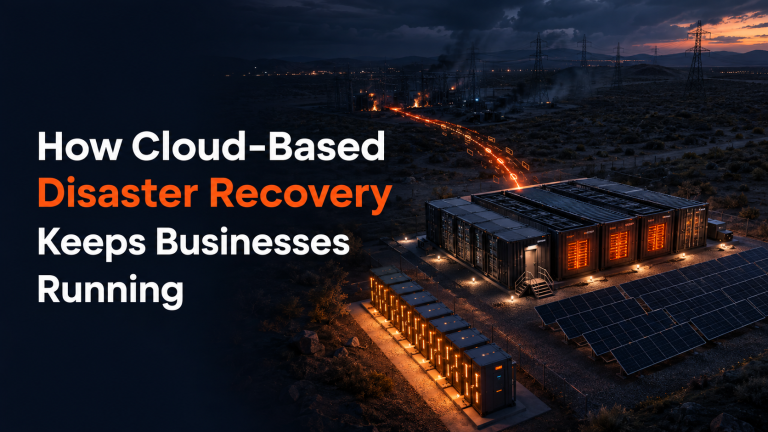


Cloud based disaster recovery keeps a business running by replicating critical systems, applications, and data to geographically distributed infrastructure, then restoring operations within defined recovery windows if an outage, cyberattack, or disaster occurs. Flux Core delivers this on renewable-powered data centers, so the recovery process itself stays running even during grid failures. Workloads shift automatically to an operational recovery node powered by solar and battery storage, keeping systems available without waiting on the utility grid to come back online.
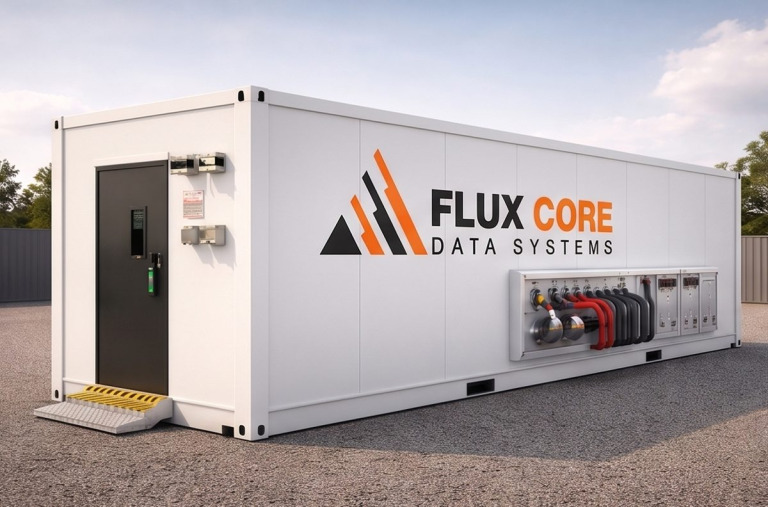
Flux Core Data Systems designs and builds containerized, renewable-powered data center infrastructure. Organizations use this infrastructure to deliver cloud based disaster recovery, business continuity, cloud computing, and other IT services to their own operations and clients. This page explains what cloud based disaster recovery is, what infrastructure capabilities support backup disaster recovery solutions, and why a renewable-powered, grid-independent foundation changes what organizations can build on top of it.
This same renewable, modular design underpins Flux Core’s full range of infrastructure work, including facilities used for cloud computing, colocation, and edge computing, so organizations delivering disaster recovery are building on the same physical foundation they already rely on for other IT services.
How Cloud Based Disaster Recovery Protects Business Continuity
Cloud based disaster recovery, or DRaaS, is a cloud computing backup and recovery model that replicates critical systems, applications, and data to geographically distributed infrastructure. In the event of an outage, cyberattack, or disaster, operations are restored within predefined Recovery Time Objectives (RTO) and Recovery Point Objectives (RPO).
Flux Core designs and builds the containerized, renewable-powered data centers that give organizations a foundation for delivering a cloud based disaster recovery service. These facilities combine distributed infrastructure with grid independence, so the sites supporting a recovery operation stay available even during grid failures. Organizations mapping this out often start with a step-by-step framework for implementation.

Why Traditional Disaster Recovery Falls Short
Traditional recovery systems depend on grid power and centralized facilities that fail during outages. The containerized data centers Flux Core builds use renewable and stored energy instead, giving organizations a foundation that keeps operating through disruptions that would otherwise take a conventional facility offline.
Most traditional disaster recovery solutions rely on centralized hyperscale data centers that remain vulnerable to regional grid outages, fuel shortages, and infrastructure congestion. The distributed, renewable infrastructure Flux Core builds reduces these single points of failure, giving the organizations that operate on it a more resilient foundation to build disaster recovery around. Traditional data centers also consume vast amounts of fossil-fuel power to begin with, which is the underlying condition that leaves both the primary environment and a same-model recovery facility exposed to the same regional grid risk at the same time.
See where a distributed, renewable-powered facility changes the foundation your disaster recovery plan is built on. Contact Flux Core to schedule a project evaluation.
Infrastructure Capabilities That Support Backup and Disaster Recovery Solutions
The containerized data center infrastructure Flux Core builds is engineered to support:
- Real-time data replication across geographically redundant sites
- Automated failover and failback capabilities
- Encrypted snapshot backups
- Multi-region disaster recovery orchestration
- 24/7 infrastructure monitoring
- Defined RTO and RPO aligned with business SLAs
These capabilities describe what the underlying infrastructure is built to support. The disaster recovery service itself, including replication management, failover orchestration, and recovery objectives, is delivered by the organizations and service providers running their operations on Flux Core’s facilities. When disruption hits, an organization’s workloads can shift to an operational recovery node built on solar and battery storage, keeping the underlying facility powered even when the utility grid is unavailable.
How Battery Storage and On-Site Power Keep Data Centers Running
Each containerized data center Flux Core builds produces and stores its own energy through integrated solar generation, battery storage, and intelligent energy management systems, so every solar-powered facility operates as a self-sustaining microgrid. Battery storage covers short duration gaps in solar production, while grid tie or on-site generation supports extended events. Facilities are designed for continuous operations, not intermittent use, which is what allows a data center built on this model to stay available for as long as a disruption lasts, giving any recovery service running on it the same durability.
Flux Core uses lithium iron phosphate batteries for their thermal stability and long cycle life, with a typical design life of 10 to 15 years depending on duty cycle. Battery systems include thermal management, monitoring, and fire suppression, following established safety standards used in energy storage deployments. Grid interconnection is optional: facilities can operate behind the meter with grid support where available, while backup generation supports resilience where required.
This same on-site power model is what allows Flux Core’s facilities to be pre-engineered and containerized, shipping ready to operate with integrated on-site power. That reduces development time, cuts risk, and delivers immediate access to infrastructure capacity without waiting on utilities or grid upgrades.
Ask how on-site battery storage supports the infrastructure your recovery timeline depends on. Schedule a call with Flux Core to discuss deployment.
Recovery Time and Recovery Point Objectives Supported by Flux Core Infrastructure
Organizations building a cloud based disaster recovery service on Flux Core’s containerized infrastructure can design around strict recovery objectives, supported by the underlying facility’s grid independence and uptime design:
- Recovery Time Objective (RTO): minutes to hours depending on deployment tier
- Recovery Point Objective (RPO): near real-time replication options available
- Continuous data protection for mission-critical systems
- Compliance-ready logging and reporting
These figures describe what the infrastructure is capable of supporting. Achieving them in practice depends on the disaster recovery service an organization designs and operates on top of the facility.
Infrastructure Behind Cloud Computing, Backup, and Recovery Services
Flux Core’s containerized data centers support a broad range of services that organizations build on top of them, including cloud computing, secure cloud storage and backup, Infrastructure as a Service, private and hybrid cloud environments, high-performance compute, and managed cloud services. Each of these depends on infrastructure engineered for uptime, scalability, and measurable sustainability performance, rather than being delivered by Flux Core itself as an IT service.
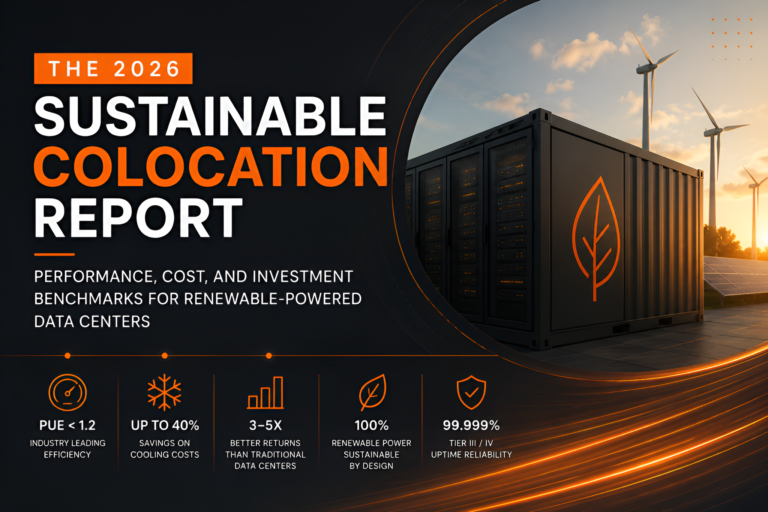
The facilities Flux Core builds maintain a Power Usage Effectiveness (PUE) below 1.2, use on-site solar and long-term wind energy contracts, and include real-time energy monitoring for peak efficiency. These facilities also meet ISO 14001 and ENERGY STAR certification standards, giving organizations a verified sustainability baseline behind the same infrastructure that supports disaster recovery. Every service built on top, including secure cloud storage and backup, runs on renewable-powered infrastructure rather than a separate, fossil-fuel-dependent facility.
The gap between this infrastructure model and traditional data center providers is measurable. Traditional providers run an average PUE of 1.5 to 1.8 on fossil-fuel-powered infrastructure with grid-dependent energy and limited carbon reporting, while the facilities Flux Core builds run on solar- and wind-backed systems with a PUE below 1.2 and real-time sustainability metrics. Liquid and free-air cooling further reduce energy waste across these facilities. See the full list of benefits this kind of infrastructure delivers.

Benefits of Infrastructure Built for Renewable-Powered Disaster Recovery
The containerized data center infrastructure Flux Core builds delivers:
- Geographic redundancy and low latency
- 24/7 monitored infrastructure supporting backup and recovery
- On-demand scalability for changing workloads
- Lower energy costs and carbon footprint
- 99.99% uptime architecture design
- Reduced dependency on centralized hyperscale providers
- Scalable infrastructure for disaster recovery solutions in regulated industries
The cost advantage behind these benefits is measurable. Renewable energy costs have fallen nearly 90% over the last decade, which is part of why the facilities Flux Core builds can lower operating costs for the organizations running on them, while also qualifying for renewable energy tax incentives.
Grid-Independent Design and Rapid Deployment
The renewable-powered facilities Flux Core builds operate independently from utility grids, maintaining uptime during blackouts or disasters. Modular deployment means new facilities are operational within 90 days, offering a sustainable, low-risk alternative to traditional data center construction.
This resilient-by-design approach delivers several advantages:
- No reliance on unstable grids or fossil fuels
- Rapid deployment and lower maintenance costs
- Scalable architecture for future growth
- Qualifies for renewable energy tax incentives
- Edge-ready infrastructure for distributed enterprise environments
Compared with hyperscale data centers, deployment timelines are measured in months rather than years, and both capital exposure and grid dependency are materially lower. Prefabricated units and scalable design shorten deployment time versus traditional data center builds, which is what makes the 90-day timeline achievable for new infrastructure capacity.
High-efficiency cooling systems built into Flux Core’s facilities cut energy use by up to 40 percent, supported by intelligent energy optimization that helps maintain the PUE below 1.2 standard across cloud, colocation, and disaster recovery infrastructure alike.
See how a 90-day deployment timeline fits the infrastructure your recovery plan depends on. Contact Flux Core to discuss deployment options.
Compliance and Security Standards Built Into Flux Core’s Facilities
Flux Core’s containerized data centers are designed to meet enterprise-grade compliance and security standards while running entirely on renewable energy:
- HIPAA, ISO, PII, and SOC 2 compliant facility standards
- Low-latency, high-availability architecture
- Encrypted infrastructure supporting cloud computing backup and recovery
- Facility architecture built to support compliance-ready cloud based disaster recovery service delivery
These facility-level standards give organizations a compliant foundation to build on. Cybersecurity monitoring runs 24 hours a day across Flux Core’s infrastructure. Combined with HIPAA, ISO, SOC 2, and PII data protection standards at the facility level, this makes the infrastructure suitable for healthcare, financial, government, and enterprise organizations that need their recovery infrastructure to meet the same compliance bar as their primary environment.
Physical security controls reinforce these digital safeguards. Private cages, racks, and suites with controlled access, continuous biometric protection, and around-the-clock monitoring are part of how Flux Core secures colocation and recovery facilities for regulated industries, supporting the audits and ESG reporting these organizations are required to produce.
What Flux Core Manages and What Organizations Retain
Flux Core designs, builds, and manages the containerized data center infrastructure, power systems, and physical operations for each deployment. Organizations that operate on this infrastructure are responsible for the workloads, data, and IT services, including any disaster recovery service, they choose to run on top of it. Ownership of the underlying energy assets can vary by project, with Flux Core supporting customer-owned, third-party-owned, and special purpose vehicle structures depending on how an organization wants to structure its infrastructure investment.
Through Compute Purchase Agreements, Flux Core provides compliant, on-demand access to this infrastructure rather than requiring an organization to build and manage its own data center hardware. AI developers, small and mid-sized businesses, and cloud providers use these agreements to secure sustainable, scalable infrastructure, including the physical foundation for disaster recovery capacity, at predictable costs. Here’s how this model compares to traditional backup systems.

Containerized Data Centers as the Foundation for Recovery
Flux Core’s containerized data centers deploy quickly, expand easily, and operate anywhere renewable energy is available. These containerized systems deploy quickly without straining community infrastructure, delivering scalable, efficient, and cost-effective compute power anywhere. Organizations then use this infrastructure to deliver their own disaster recovery, colocation, or cloud services in decentralized locations.
Flux Core works with landowners and investors to develop distributed infrastructure networks that add both resilience and revenue. These modular systems reduce deployment timelines compared to traditional brick-and-mortar facilities while giving organizations enterprise-grade infrastructure for disaster recovery in decentralized locations. This same distributed architecture also supports compliance-ready infrastructure for data sovereignty requirements and hybrid cloud-edge orchestration.
Flux Core’s modular deployment process moves through defined stages: an assessment and feasibility study, site preparation and renewable integration, modular deployment and testing, and ongoing optimization and monitoring. Each stage is built around the same pre-engineered, containerized units used across Flux Core’s cloud, colocation, and disaster recovery infrastructure, which is part of why new capacity can be added in weeks to months rather than years.
Each deployment functions as a renewable-powered modular data center engineered for high-density AI workloads and enterprise reliability standards, so the same facility built to support an organization’s primary compute needs can also support its recovery infrastructure without a separate design standard. Revenue streams built on this model include hosting services and Compute Purchase Agreements, giving landowners and investors a way to fund recovery-ready infrastructure that also generates ongoing value.
How Flux Core’s Infrastructure Supports Financial Institutions
Flux Core designs and builds data center infrastructure for banks, engineered for high security, consistent uptime, and regulatory-ready facilities, with each site operating on a dedicated microgrid with solar generation and storage. This grid-independent design gives financial institutions a resilient infrastructure foundation for running their own disaster recovery, fraud detection, and digital banking operations, while lowering carbon impact.
Advantages of this infrastructure for financial institutions include multi-layered physical and cybersecurity controls, low-latency connectivity for trading, payments, and fraud monitoring, infrastructure aligned with ESG reporting, and independent power supported by solar generation and battery storage. Flux Core’s data center infrastructure for banks lists disaster recovery support through grid-independent power directly alongside encrypted storage capacity for core financial systems, high-density computing capacity for AI-based fraud detection and risk modeling, and real-time facility monitoring and uptime assurance. Redundant power pathways supported by the microgrid keep the underlying facility operating consistently, so the banking systems, payment networks, and digital channels a financial institution runs on top of it stay available, backed by continuous biometric protection and around-the-clock monitoring.
Talk to Flux Core about the grid-independent infrastructure your financial recovery plans depend on. Contact Flux Core to explore microgrid-powered data center infrastructure for banking and financial services.
How Flux Core’s Infrastructure Supports Retail and eCommerce Continuity
Retail organizations need consistent uptime, secure payment processing, and low-latency connectivity across stores, ecommerce platforms, and logistics. Flux Core builds retail colocation infrastructure powered by a dedicated microgrid using on-site solar generation and storage, engineered to support demanding retail workloads from point-of-sale systems to real-time analytics that retail organizations run on top of it.
This grid-independent approach lowers carbon impact through independent solar generation and provides predictable power costs supported by on-site microgrids. It gives retail operations across ecommerce platforms, store networks, distribution centers, and fulfillment systems a stable infrastructure foundation for growth without raising their environmental impact.
Colocation Adds Another Layer of Redundancy
Disaster recovery infrastructure does not have to stand alone. Flux Core’s colocation facilities let organizations host their servers in secure, professionally managed environments with high-speed connectivity, redundant power, and 24/7 monitoring, backed by verified low PUE ratios. Organizations in finance, healthcare, ecommerce, and technology use these colocation facilities alongside disaster recovery infrastructure for secure, scalable, renewable-powered hosting.
Pairing colocation with a cloud based disaster recovery service gives an organization redundant power and monitoring at its primary hosting environment, in addition to the failover-ready infrastructure a recovery site provides. Both run on the same renewable, grid-independent model, so neither layer of infrastructure reintroduces the fossil-fuel and centralized-grid dependency that disaster recovery is designed to remove. Flux Core’s modular colocation facilities scale from single racks to full suites, which allows an organization to size its redundant hosting footprint to match its own recovery plan.
Where Flux Core Deploys Data Center Infrastructure
Flux Core deploys containerized data centers across U.S. regions, including rural, suburban, and edge sites. This flexible design supports edge computing and regional cloud infrastructure close to end users, which is part of what allows organizations to place the recovery infrastructure they operate near the businesses they serve, rather than relying on a small number of distant hyperscale facilities.
Flux Core serves enterprises, AI developers, small and medium businesses, investors, landowners, and data center operators across the United States. Modular design works well for organizations that need rapid deployment, scalability, and sustainable infrastructure, whether that need is a primary compute environment, a colocation footprint, or the physical foundation for a disaster recovery service. A single module fits on a small industrial or rural parcel, with flat land, access roads, and basic utility access supporting deployment, which is part of what keeps site selection flexible for a distributed infrastructure network.
Industries That Rely on Flux Core’s Infrastructure for Continuous Operations
Organizations across regulated and high-availability industries build their own continuity programs on Flux Core’s infrastructure:
- Healthcare organizations requiring HIPAA-compliant infrastructure for backup disaster recovery solutions
- Financial institutions requiring low-latency infrastructure for cloud computing backup and recovery
- Government and public sector organizations requiring grid-independent, resilient facilities
- SaaS providers requiring multi-region infrastructure to run a cloud based disaster recovery service
- Enterprise organizations pursuing ESG-aligned infrastructure strategies
Talk to Flux Core about the infrastructure your industry’s continuity planning depends on. Get in touch to discuss your requirements.
Why Flux Core’s Experience Strengthens the Infrastructure Behind Recovery Outcomes
Flux Core is a veteran- and minority-owned company with decades of expertise in solar, storage, and cloud infrastructure, designing and building sustainable data centers that strengthen both business and community. Flux Core combines manufacturing expertise with renewable energy integration, positioning the company at the intersection of sustainable infrastructure and high-performance compute.
Flux Core focuses on the physical and power infrastructure that organizations need to deliver disaster recovery, cloud, and other IT services on their own, bridging the gap between facility resiliency and energy independence rather than operating those IT services itself. Flux Core’s partnerships extend across three groups:
- Landowners converting idle property into revenue-generating hubs
- Investors seeking resilient, high-yield digital infrastructure
- Organizations committed to reliable, ESG-aligned operations
For investors, energy volatility is a primary risk factor in data center investments, and integrating on-site renewable power and storage lowers exposure to grid congestion and utility pricing risk. Rather than selling excess electricity back to the grid at wholesale rates, Flux Core’s infrastructure model monetizes renewable energy directly through compute hosting, AI processing, and data storage capacity, including the physical foundation for disaster recovery, which is part of why these deployments can deliver returns three to five times higher than traditional data centers built on legacy grid economics.
Turn your land or infrastructure into a site for containerized, renewable-powered data centers. Contact Flux Core to schedule a project evaluation or infrastructure partnership.
Bringing Cloud, Colocation, and Recovery Infrastructure Together
Disaster recovery works best when the infrastructure underneath it is not a separate system bolted onto an organization’s primary environment. Across the facilities Flux Core builds for cloud computing, colocation, and disaster recovery, the same renewable, grid-independent architecture, the same PUE below 1.2 standard, the same facility-level compliance framework, and the same 90-day modular deployment model apply consistently. An organization building a cloud based disaster recovery service on Flux Core’s infrastructure is not building on a different power model, a different compliance posture, or a different deployment timeline than the one already supporting its other IT services.
That consistency is what allows the recovery objectives an organization designs to hold up under real conditions rather than remaining theoretical. Grid independence keeps the underlying facility powered through the disruptions that would otherwise take a conventional site offline. What an organization builds on top, automated replication and orchestration, turns that power into fast RTO and RPO instead of a manual restore process. Each layer depends on the others, which is why Flux Core builds the infrastructure foundation for disaster recovery rather than operating it as a managed IT service itself.
Frequently Asked Questions
A cloud backup and recovery framework defines how critical data and systems are backed up, replicated, recovered, tested, and maintained following a disruption.
Key steps include identifying critical systems, defining RTO and RPO targets, selecting replication methods, choosing recovery infrastructure, documenting procedures, and testing failover.
RTO defines how quickly a system should be restored, while RPO determines how much data loss the organization can tolerate after an outage.
Geographic separation can reduce the risk of the primary and recovery environments being affected by the same regional power failure or disruption.
Businesses should evaluate power reliability, geographic redundancy, scalability, security, compliance requirements, monitoring, and deployment timelines.