
Let’s build the future of sustainable data together.

Let’s build the future of sustainable data together.

Solar powered data centers are emerging as a high-value infrastructure strategy practical way for solar farm owners to convert renewable generation into long-term digital infrastructure revenue. Instead of selling electricity back to the grid at volatile prices, data centers powered by solar energy consume power directly on-site, creating higher-value utilization of clean energy assets. Flux Core Data Systems enables solar-powered data center deploymentsthrough modular, energy-efficient data centers designed to operate alongside existing and planned solar installations.
By consuming power on-site, solar powered data centers convert excess solar generation into contracted compute capacity, transforming electricity into predictable, long-term infrastructure revenu beyond traditional grid sales.
Renewable energy data centers integrate directly with solar generation and battery storage systems. This architecture enables solar powered data centers to operate independently of grid congestion and interconnection delays.maintaining predictable operating costs. Solar farms can support data centers by providing steady daytime generation backed by storage for round-the-clock availability.
These facilities are engineered to align compute demand with energy availability, reducing curtailment and stabilizing revenue. Energy efficient data centers improves solar utilization by lowering power overhead through optimized cooling, layout, and power distribution.

Yes. Modern data centers powered by solar energy combine on-site generation, battery systems, and workload scheduling to support continuous operation. While solar alone is intermittent, hybrid solar and storage configurationsenable reliableuptime without relying on grid expansion.
Key technical enablers include:
Solar farms already possess the core inputs data centers require: land, power, and permitting alignment. By co-locating infrastructure, owners avoid grid interconnection queueswhile increasing the value of each megawatt generated.
This approach enables landowners to:
Excess generation becomes more valuable when converted into compute rather than exported to the grid. Data centers create scalable demand-side consumption that scales with solar output and storage capacity.
Common monetization structures include:
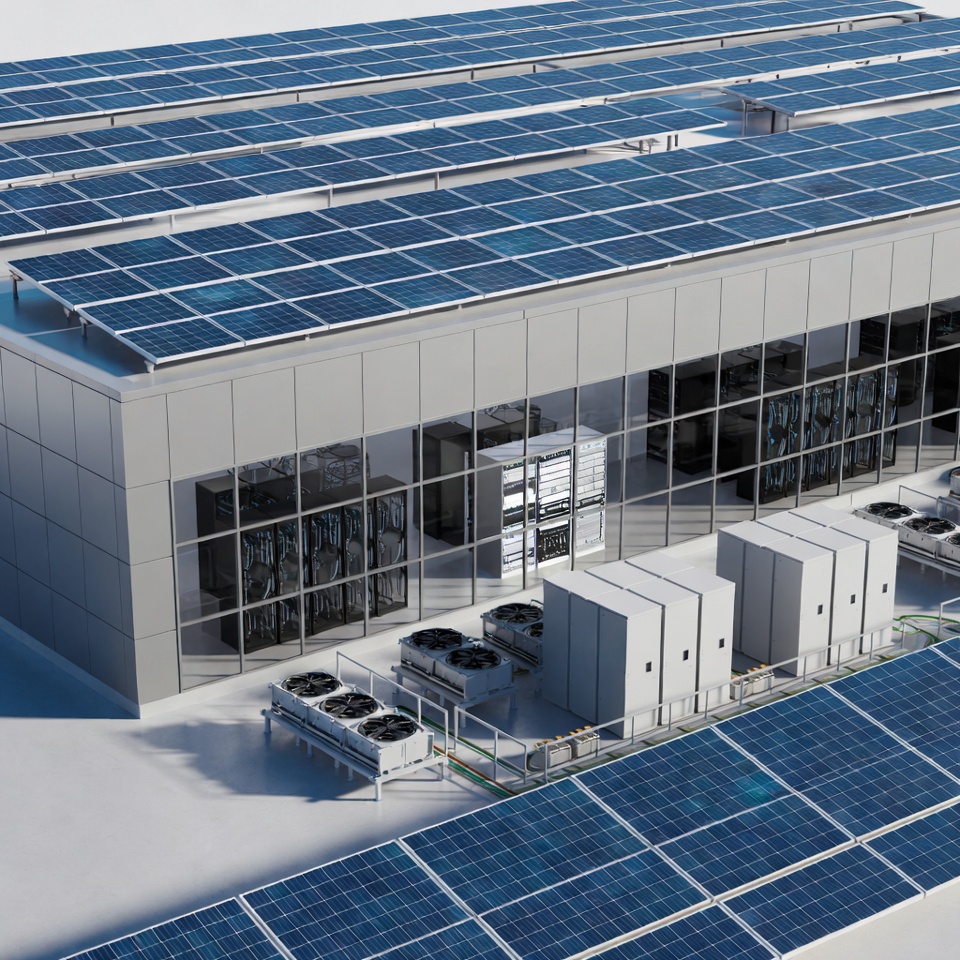
Energy efficient data centers maximize the economic return of each kilowatt produced. Lower cooling loads and optimized power distribution allow more compute to run on the same solar footprint.
Efficiency advantages include:
Turning Solar Generation Into Digital Infrastructure Value
Solar powered data centers provide solar farm owners with a scalable path to monetize clean energy beyond utility offtake agreements . By pairing renewable energy data centers with modular, energy efficient infrastructure, excess solar power becomes a durable, infrastructure-grade revenue engine. Partnering with an experienced infrastructure operator enables solar assets to support data centers reliably, sustainably, and profitably.
Discover how solar-powered data center partnerships can unlock new revenue from existing or planned solar assets. Connect with Flux Core Data Systems to evaluate site suitability, power alignment, and monetization models.
Yes. With on-site solar generation, battery storage, and efficient design, data centers operate reliably without grid dependence.
Excess generation is consumed on-site by data centers, converting electricity into long-term compute revenue instead of wholesale power sales.
Higher efficiency allows more compute output per megawatt, improving uptime, cost control, and return on solar assets.