
Key Facts: Containerized Data Centers and Cloud Computing, Explained
Containerized data centers package power, cooling, networking, and compute inside pre-engineered shipping-container modules. Each module can be activated in months, not the years a conventional data center build takes. It also delivers roughly one megawatt of compute capacity. A cloud computing provider adds capacity in fixed, repeatable increments instead of committing to one oversized facility upfront. Because the units are self-contained and portable, they can be sited close to renewable power or end users. This keeps cost and latency tied to actual demand, not a multi-year construction forecast.
The main takeaway: For a cloud computing company, the constraint is no longer how large a facility to build, but how fast capacity can follow demand. Containerized modules ship pre-integrated, activate quickly, and expand incrementally. This removes the overbuilding and grid-interconnection risk baked into traditional construction. Flux Core Data Systems & Energy Inc. provides sustainable, solar-powered data centers to businesses across the USA, monetizing renewable generation as compute rather than selling it back to the grid at wholesale rates.
Demand for compute is climbing faster than traditional facilities can be delivered. AI training clusters, always-on platforms, and enterprise systems all compete for the same power and floor space, while grid interconnection queues and lengthy construction schedules keep new supply from arriving on time. A cloud computing provider caught in that gap faces an uncomfortable trade-off: commit capital to a large build sized for a demand curve that may never materialize, or lose ground to rivals that can bring capacity online sooner.
Containerized infrastructure offers a different route. By relocating the data center into a standardized, factory-integrated enclosure, providers separate growth from construction and treat capacity as something that ships and switches on, not something built over years. That shift matters even more given where the market is heading: the global push toward AI infrastructure and ESG compliance is accelerating demand for renewable-powered data centers, and infrastructure decisions now weigh sourcing, siting, and emissions alongside cost and capacity. The sections below unpack what a containerized data center is, why cloud computing companies are rethinking capacity, and what to evaluate in an infrastructure partner, with Flux Core Data Systems’ modular, renewable-powered approach as the practical reference point throughout.
New to modular operators and want the background first? See how Flux Core pairs renewable energy with digital infrastructure.
What Is a Containerized Data Center?
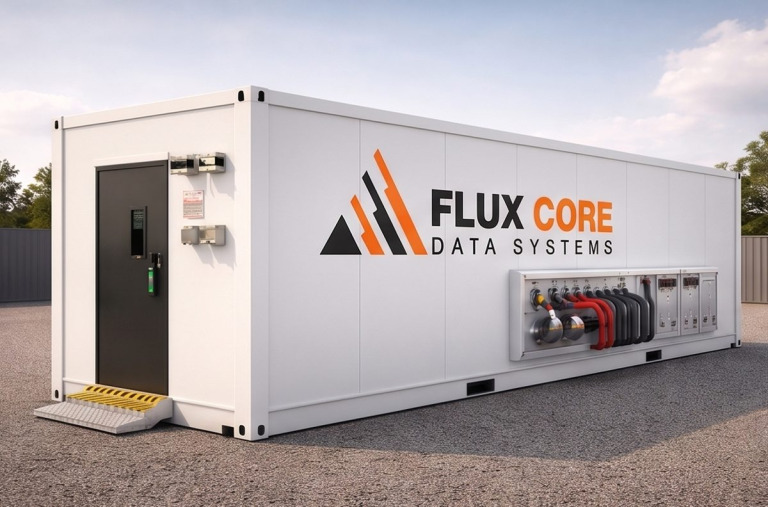
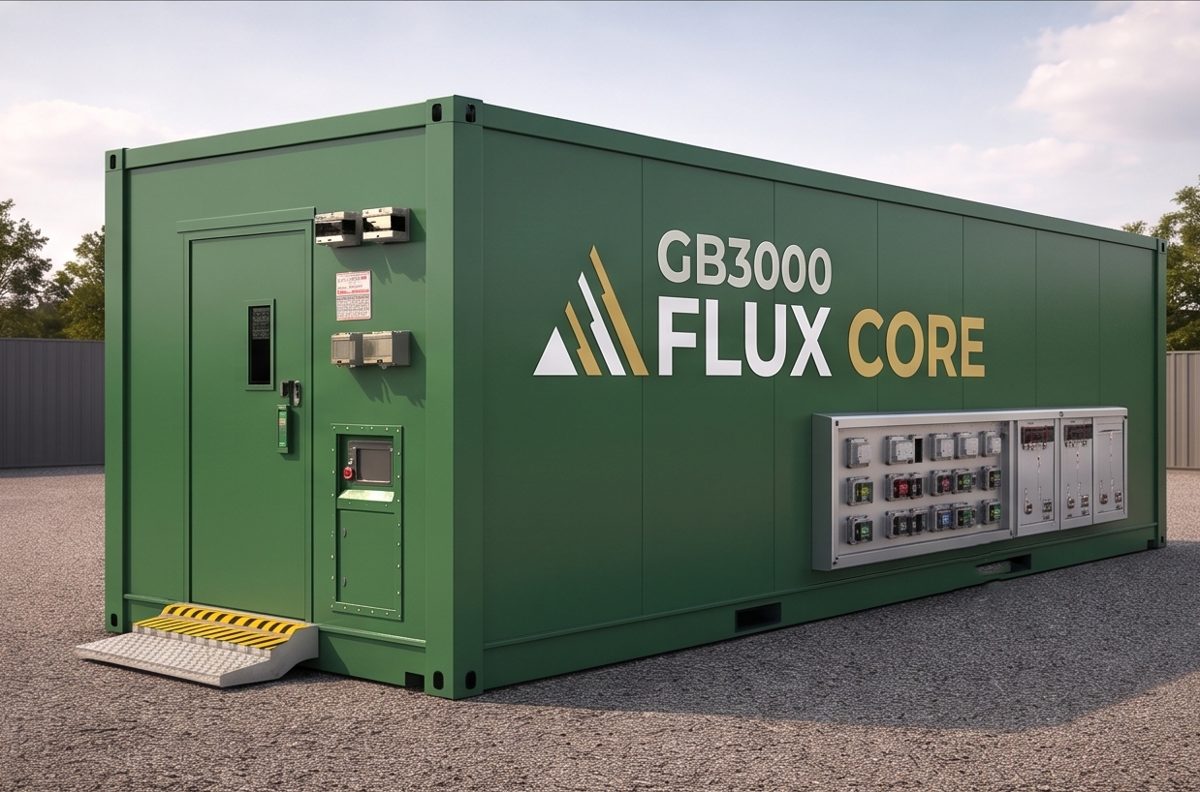
A containerized data center is a pre-engineered computing facility built inside a standardized shipping container, with power distribution, cooling, networking, security, and monitoring fully integrated before the unit ever reaches the site. Once delivered, it deploys directly and begins operating without the civil works and permitting cycles a traditional facility requires. In practical terms, it compresses the data hall, the electrical room, and the cooling plant into a single transportable enclosure that arrives ready to run.
Each enclosure acts as a self-contained building block. A Flux Core module is built around a 48-foot container, roughly 8.5 feet wide and 9.5 feet tall, and delivers one megawatt of compute capacity. Because the design is standardized and repeatable, providers scale by adding containers as demand grows rather than overbuilding a single large facility upfront. That repeatability also compounds operationally: each deployment follows the same playbook, so siting, commissioning, and integration grow more efficient with every unit.
A containerized unit also functions as a portable data center. It can be positioned in remote, energy-rich, or latency-sensitive locations that conventional campuses cannot easily reach, which makes it well suited to AI workloads, edge computing, and rapid capacity expansion. That mobility means capacity can be redeployed as demand shifts rather than stranded in a fixed site a flexibility that fixed brick-and-mortar builds simply cannot match.
Inside each module, the build is genuinely pre-assembled rather than finished on-site: solar generation is paired with smart inverters for stable power conversion, cooling is calibrated to rack density with AI-driven controls rather than fixed setpoints, and network and power equipment ship already rated for continuous operation. That level of pre-assembly is what turns commissioning into a delivery-and-connect process instead of a multi-month build, and it is why a unit performs the same way on day one as it does a year in.
How Does a Containerized Data Center Differ from a Traditional Facility?
The clearest way to grasp the model is by contrast with how facilities have always been built. A conventional data center is a fixed structure: its power capacity, cooling plant, and floor area are locked in during design and are expensive and slow to change once the building exists. A containerized unit inverts those assumptions. It is manufactured, integrated, and tested in a controlled setting before it ships, so the extensive on-site civil work that dominates a traditional schedule is largely removed from the critical path.
That difference carries through the entire lifecycle. Where a legacy build commits an operator to one location and one capacity ceiling for decades, a modular fleet can be extended, reconfigured, or relocated as requirements shift. A cloud computing company is no longer betting on a single forecast at a single site; it is assembling capacity from repeatable units it can move where power, land, and demand actually line up.
For a side-by-side breakdown of both models, see comparing containerized and traditional data centers for growing cloud computing providers.
Want the full breakdown of speed, cost, and flexibility? Take a closer look at modular container data centers.
Why Cloud Computing Companies Are Rethinking Their Infrastructure
The economics of adding capacity have shifted. Conventional facilities can take 18 to 36 months to build, and even then they depend on grid interconnection that may lag years behind schedule for a cloud computing company trying to keep pace with AI and enterprise demand; that delay costs product velocity and market share, not just time. Traditional builds compound the problem by forcing providers to size infrastructure for projected peaks, sinking capital into space that sits idle until demand catches up, if it ever does. Modular deployment inverts that logic: capacity expands only when demand materializes, so spend tracks usage rather than forecasts the same principle behind renting GPU capacity instead of buying it.
For a closer look at what is driving that shift, see 7 reasons cloud computing companies are moving to containerized data centers.
The way returns are generated is changing too. As AI reshapes infrastructure economics, revenue increasingly scales with compute utilization rather than square footage, so what matters is not how much floor space a facility holds but how quickly it can be filled with productive, high-load compute. Energy alignment reinforces that shift: because modular systems can be sited next to renewable generation, they reduce grid dependency and improve operational stability, offering a practical alternative to concentrating everything in centralized hyperscale facilities that are increasingly difficult to power and permit. Much of that stability comes from running behind-the-meter generation and consumption on-site rather than drawing it through the public grid, which sidesteps interconnection queues and the demand charges that make grid-tied capacity harder to price predictably.
Scale your AI compute now without a multi-year build.
How Containerized Infrastructure Supports Cloud Computing Providers
For a cloud computing provider, the core benefit is elastic physical capacity. Instead of a single expansion project, growth becomes a sequence of modules added as contracts and utilization justify them. Each unit arrives pre-configured, so on-site work is limited to placement, power connection, and network integration, and many deployments reach full operation in weeks. That cadence lets providers commit capacity to customers with confidence, not hope.
The model also reshapes how customers pay for capacity. Rental and agreement structures convert infrastructure spend from a large capital outlay into an operating expense aligned to project timelines, removing upfront construction and hardware purchases. Structured terms improve cost predictability, and deployment timelines shorten because the infrastructure is designed for the workload rather than retrofitted from general-purpose space.
Flux Core supports flexible engagement models so providers can align spend with the rhythm of their workloads rather than a fixed footprint:
| Engagement model | Best suited to |
|---|---|
| Hourly data center rental | Short-duration AI training, testing, and burst workloads |
| Monthly data center rental | Sustained inference, fine-tuning, and production environments |
| Compute Purchase Agreements (CPAs) | Longer-term access that converts renewable energy into contracted digital capacity |
Some workloads need isolation as much as scale. Dedicated GPU clusters with custom network and storage configurations give providers and their regulated customers private environments for sensitive data, with compliance alignment and predictable performance under sustained load. This lets a provider meet data-sovereignty and security requirements without standing up separate facilities.
Placement matters as much as capacity. Because modules can operate close to end users and data sources, they support the low-latency, decentralized compute that cloud computing hosting increasingly depends on. Providers serving AI developers and enterprises can distribute workloads across sites pushing processing toward the edge where milliseconds count, while keeping heavier training runs where power is cheapest and cleanest.
Which AI and Enterprise Workloads Do the Modules Run?
The point of elastic capacity is the work it carries. Flux Core’s GPU-accelerated modules are built for compute-intensive workloads: large language model training and fine-tuning, computer vision, scientific computing, and enterprise-scale inference. These are exactly the jobs that overwhelm general-purpose facilities, because they demand sustained high-density power and cooling modern GPU servers alone can draw 6 to 15 kW each rather than the lighter, bursty patterns older infrastructure was sized for. Matching the enclosure to the workload, instead of retrofitting space never designed for it, keeps performance predictable under heavy, continuous load.
Where that compute physically sits matters just as much for certain jobs. Because the modules are distributed and operate closer to end users and data sources, they reduce latency and transmission costs for edge computing deployments, which is decisive for real-time inference and interactive applications. Providers can split a workload accordingly: run latency-sensitive processing at the edge where milliseconds decide the user experience, and keep large training runs where clean power is most abundant, all coordinated as one distributed environment rather than a patchwork of disconnected sites.
Match capacity to demand instead of overbuilding. Explore hourly and monthly GPU data center rental.
What Cloud Computing Hosting Operators Look for in Infrastructure Partners
When a cloud computing provider entrusts customer workloads to an outside partner, the evaluation goes well beyond price per rack. Reliability comes first. Flux Core operates Tier III and Tier IV-level facilities with multi-layered redundancy and 99.999% uptime, backed by biometric access, advanced fire suppression, and continuous on-site monitoring. For mission-critical hosting, that redundancy is the difference between a contained event and a customer-facing outage.
Compliance and continuity follow closely. Regulated workloads demand infrastructure aligned with frameworks such as HIPAA, ISO, PII, and SOC 2, along with defined recovery objectives when something fails. Because Flux Core’s sites are distributed and renewable-powered, they reduce the single points of failure centralized facilities carry, and they can host cloud computing backup and recovery with real-time replication and automated failover that keeps running even during grid disruptions. This matters most for regulated, always-on sectors healthcare providers, financial institutions, and retail operators all depend on the same continuity the model is built to deliver.
Operators also weigh how easily they can move in. A credible partner supports migration from legacy infrastructure, private data centers, or cloud-heavy environments through a structured assessment, planning, and execution process that minimizes downtime. That transition support turns a risky cutover into a managed project, which is often the deciding factor for teams that cannot afford disruption to live services.
Together, these map onto a simple pattern: reliability and security are what get a workload onto the platform in the first place, while continuity measured through defined recovery time and recovery point objectives (RTO/RPO) and predictable energy costs are what keep it there for the life of a contract.
How Is Redundancy Engineered Beneath the Headline Uptime Number?
A 99.999% uptime figure only means something if the engineering behind it holds up. The substance is multi-layered redundancy rather than a single safeguard: redundant power and cooling so routine maintenance or a component fault doesn’t become a customer-facing outage. Connectivity follows the same discipline through redundant network routes and customizable power configurations, backed by built-in disaster recovery, so a single disruption does not sever a customer’s workloads from the network.
For a cloud computing provider, this is the practical substance behind a service-level promise. The redundancy is designed at the module level and then multiplied across a distributed, renewable-powered footprint, so resilience is not concentrated in one vulnerable campus. That combination redundant power, redundant cooling, and redundant network routes running on self-generated energy is what actually delivers continuity, rather than simply claiming it..
Comparing managed options for your own hardware? See renewable-powered colocation built for enterprise workloads.
The Sustainability Case for Containerized Data Centers
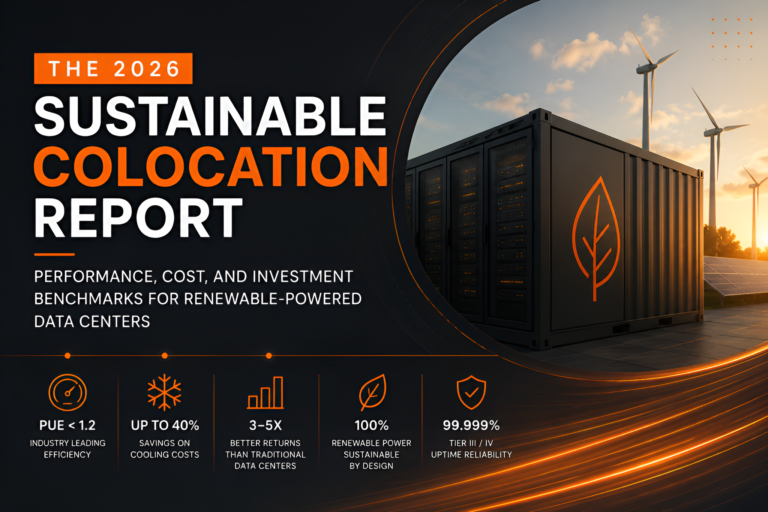
Sustainability and performance are no longer separate conversations for cloud computing companies; they are the same one. Flux Core’s containerized sites operate independently from the grid, generating and storing their own power through integrated solar and battery systems so each unit runs as a self-sustaining microgrid. These facilities maintain a Power Usage Effectiveness (PUE) below 1.2, and their energy-efficient cooling can cut power use by up to 40% compared with conventional approaches.
The environmental gains compound across a distributed footprint. Operating off-grid removes interconnection delays and eases strain on local power systems, while siting compute closer to generation reduces transmission loss and spreads power, cooling, and land use across regions instead of concentrating them at a single site. Minimal water use and lower carbon intensity per compute unit shrink the footprint of every workload the provider runs.
For providers with ESG commitments, the model turns reporting from a burden into an advantage. Flux Core supports Scope 1, 2, and 3 emissions monitoring and verified carbon-removal investments, giving customers transparent, standardized visibility into performance rather than aspirational claims. That transparency is increasingly a procurement requirement, not a nice-to-have.
Crucially, this is also a financial argument. By converting renewable energy directly into compute capacity instead of selling it back to the grid at wholesale rates, Flux Core sites can deliver returns three to five times higher than traditional data centers. Clean energy stops being a commodity and becomes a productive input, so sustainable design increasingly aligns with commercial performance rather than competing against it.
Solar is not the only renewable input in the model. Depending on what a site has access to, Flux Core also builds wind-powered, tidal-powered, and biogas-powered configurations, applying the same off-grid, self-generating design to whichever renewable source performs best at a given location.
What Standards and Lifecycle Practices Back These Claims?
Credible sustainability rests on recognized standards, not assertions. Flux Core aligns its operations with ISO 14001 environmental management and ENERGY STAR efficiency benchmarks, giving cloud computing companies external reference points for how the infrastructure is run and measured. Paired with Scope 1, 2, and 3 monitoring and verified carbon-removal, these frameworks let a provider report against its commitments with evidence that will withstand procurement and audit scrutiny.
The environmental case also extends to the hardware itself. Because the design is modular and standardized, components can be reused and redeployed rather than discarded, which reduces electronic waste over the life of a fleet. Instead of the wholesale demolition and rebuild a fixed facility eventually faces, individual modules and their equipment can be refreshed or relocated, so each refresh cycle’s footprint shrinks alongside the footprint of daily operation.
How Does On-Site Generation Stabilize Long-Term Energy Costs?
Energy price volatility is one of the largest uncontrolled variables in running compute at scale. Because each Flux Core site generates and stores its own power as a self-sustaining microgrid, it is insulated from the swings and surcharges that grid-dependent facilities absorb. For a cloud computing provider planning multi-year customer contracts, that on-site generation converts an unpredictable operating cost into a far more stable one, making long-term pricing easier to commit to and defend. Clean energy here is not only an emissions story; it is a hedge that steadies the economics underneath every workload the provider hosts.
See how clean generation becomes compute. Explore the solar-powered data center model.
Inside Flux Core’s Approach to Building Containerized Infrastructure
Flux Core Data Systems deploys containerized data centers that run on resilient, on-site energy, with each system integrating solar generation, battery storage, and optional backup power for continuous operation. Deployments reach full operation in as little as 90 days, and because the architecture is modular, capacity expands from a single unit into larger clusters with no fundamental redesign. The company builds the generation and the compute as one system rather than bolting clean power onto a conventional facility.
That integration is what sets the approach apart. Flux Core is a veteran- and minority-owned company with decades of experience in solar, energy storage, and data infrastructure, and its fully off-grid design gives it a distinct market position. Through Compute Purchase Agreements, it converts renewable generation into reliable digital capacity for enterprises, AI developers, and cloud providers seeking decentralized, low-latency compute, reducing costs and expanding access across the U.S. digital economy.
That footprint is already regional rather than local: Flux Core lists dedicated locations for states such as California, Texas, Arizona, Nevada, Florida, North Carolina, and Georgia extending the same site-selection approach to wherever power, land, and demand line up.
The revenue model reinforces the engineering. Because each site monetizes clean energy as hosting, Compute Purchase Agreements, energy arbitrage, and renewable-energy incentives, the same infrastructure that lowers a provider’s costs also generates durable returns for the landowners and investors who help develop it. Sustainability and profitability are designed to move together rather than trade off.
The model is built for organizations that run mission-critical infrastructure and need predictable capacity without the drag of construction from AI model training clusters and edge deployments to remote enterprise expansion. It targets enterprise- and provider-scale workloads rather than the smallest use cases, reflecting the density and reliability that AI and cloud operations require. Every site pairs 24/7 monitoring, cybersecurity, and backup redundancy with clean, low-cost compute, so a serious cloud computing company gets both efficiency and operational rigor in one package.
How Does the Land and Revenue Model Work?
What lets Flux Core build clean generation and compute as one system is a model that aligns everyone with a stake in the site. Rather than requiring landowners to build anything, the company works directly with them under long-term site leases: the landowner retains ownership and receives predictable, multi-year lease income, while Flux Core designs, builds, and operates the facility. Landowners participate without owning, financing, or operating the infrastructure, and Flux Core forms project-level SPVs with investors and landowners to develop each site, turning underused property and clean energy into income-producing digital assets.
This is the practical meaning of the company’s guiding idea: own the energy, monetize the data. The same arrangement that lowers a provider’s compute cost also creates durable returns for the partners who help bring a site online, because the infrastructure earns through hosting, Compute Purchase Agreements, energy arbitrage, and renewable-energy incentives. Growth for the provider and value for the landowner are engineered to move in the same direction, not compete for the same dollars.
How Durable Is the Underlying Infrastructure?
Capacity planning depends on the assets behind it lasting. Flux Core’s sites use lithium iron phosphate battery storage chosen for its thermal stability and long cycle life, and the systems are engineered for continuous operation rather than intermittent use. Because the design is modular, operators can recycle and refresh hardware rather than discard it, and low-impact operations further reduce waste. That combination underpins the long-term capacity planning a cloud computing company needs, because the site’s foundation is durable, maintainable infrastructure rather than a short-lived, single-purpose build.
Ready to add capacity that follows demand? Request a quote for a modular, renewable-powered deployment.
Where Containerized Infrastructure Leaves Cloud Computing Companies
The pressures reshaping digital infrastructure — surging AI demand, constrained grids, and tightening sustainability expectations — all point in the same direction. A cloud computing company that can add capacity in months, site it near clean power, and pay for it as demand arrives holds a structural advantage over one still tied to multi-year builds. Containerized data centers make that advantage possible by turning capacity into a modular, repeatable, portable asset instead of a fixed, front-loaded bet.
That advantage is becoming the baseline rather than the exception. As AI, edge processing, and sustainability reporting reshape what providers are expected to deliver, months-long deployment, built-in redundancy, and on-site energy are turning from a competitive edge into a minimum requirement. Providers still evaluating a traditional build are effectively pricing in a delay their competitors no longer accept. For a cloud computing provider, that is what this ultimately comes down to: infrastructure that follows demand instead of dictating it.
Contact Flux Core Data Systems to explore how modular, renewable-powered infrastructure can support your compute roadmap.
Frequently Asked Questions
A containerized data center is a pre-engineered computing facility built inside a standard shipping container, with power, cooling, networking, security, and monitoring integrated before delivery. It ships to site and begins operating without traditional construction, so it activates in a fraction of the time a conventional build takes.
They let a cloud computing company add capacity one module at a time as demand appears, rather than committing to a single oversized build. Each unit arrives pre-configured and can become operational in weeks, so growth tracks utilization and capital isn’t locked into idle space.
Yes. Flux Core operates Tier III and Tier IV-level facilities with 99.999% uptime, redundant power and cooling, biometric access, and continuous monitoring, and supports HIPAA-, ISO-, PII-, and SOC 2-aligned deployments — the reliability and compliance standards enterprise hosting requires.
Flux Core’s modular units reach full operation in as little as 90 days, compared with the 18 to 36 months typical of traditional facilities, because the systems are built and tested off-site and need only placement, power connection, and network integration on arrival.
Flux Core’s containers run off-grid on integrated solar and battery power as self-sustaining microgrids, maintain a PUE below 1.2, use efficient cooling that can cut power use by up to 40%, and convert renewable energy directly into compute—lowering emissions while stabilizing long-term energy costs.
Traditional cloud computing hosting concentrates capacity in large, grid-dependent facilities with long lead times. Containerized infrastructure distributes smaller, renewable-powered modules closer to power and users, so it activates faster, scales incrementally, and reduces exposure to grid congestion.