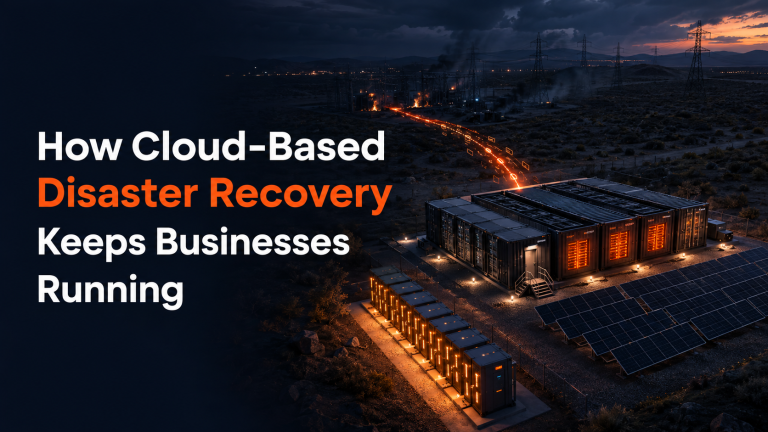

Disaster recovery plans are built around one quiet assumption: the backup site will have power when the primary site doesn’t. That’s not always true. Power outages, rolling blackouts, and storm-related disruptions tend to hit entire regions at once, so a recovery site sharing a grid with the primary facility can go dark at the exact moment it’s needed most.
Fast recovery is supposed to mean restoring critical systems in days, not months. That promise only holds if the recovery site has power to begin with. Flux Core Data Systems & Energy Inc. built its approach around that exact gap, starting from the power layer up.
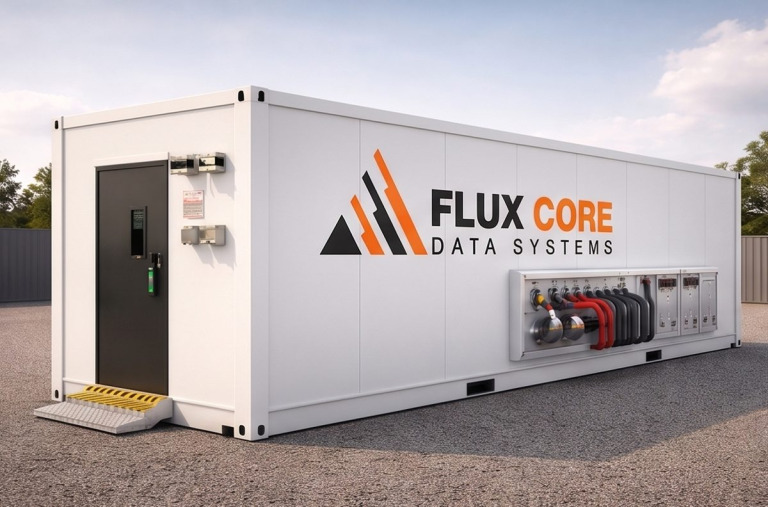
Its containerized, renewable-powered data centers generate and store their own energy on-site, so recovery capacity doesn’t inherit the same vulnerability as the systems it’s protecting. This guide walks through what cloud based disaster recovery actually involves, why utility-dependent models fall short, and how the backup and recovery architecture is built, along with what to look for in a recovery infrastructure partner. The same modular, solar-powered approach runs through all of it, the one behind the broader containerized data center model.
Cloud-based disaster recovery keeps an organization’s systems and data recoverable at a separate site when the primary environment goes down, whether the cause is a storm, a power failure, a hardware fault, or a cyberattack. Most recovery sites still depend on the same regional power grid as the facility they protect, so a widespread outage can take the backup down along with the primary. Flux Core’s recovery sites run on-site solar generation and battery storage as a self-sustaining microgrid, so they stay operational through conditions that would stall a utility-dependent facility. Each module activates in weeks rather than years, letting an organization add renewable-powered recovery capacity where it is actually needed.
The Main Takeaway: A recovery plan is only as resilient as the power behind it. Flux Core Data Systems & Energy Inc. builds cloud-based disaster recovery infrastructure on renewable, off-grid power, so recovery sites stay online during the exact conditions, power outages and regional disruptions, that most often trigger a failover in the first place.
What Is Cloud-Based Disaster Recovery?
Cloud based disaster recovery, sometimes called disaster recovery as a service, copies an organization’s systems, applications, and data to a separate location. If the primary environment fails, operations can resume there within set recovery targets. Instead of restoring everything from physical backup tapes or rebuilding a damaged facility, the organization switches over to infrastructure that’s already standing by, configured, and synced with current data.
A working deployment usually combines a few pieces:
- Continuous or near-continuous data replication to that separate site
- A secondary compute environment ready to take on production workloads
- Automated failover that redirects traffic once the primary site is confirmed down
- Encrypted snapshot backups for point-in-time recovery
- Compliance-ready logging and reporting for audits after an incident
That’s a different job than ordinary data backup, and the next section breaks down exactly where the two diverge.
How Is Full Recovery Different from Simple Backup?
A backup is simple: a point-in-time copy of data, stored somewhere separate from production, ready to restore if something breaks. It answers one question: can we get the data back?
Disaster recovery asks a harder one: can we keep the business running while the primary environment is down? That takes more than a copy of files sitting in storage. It takes a standby compute environment, a failover process that’s actually been tested, and infrastructure that can absorb production traffic on short notice.
This is where a lot of backup disaster recovery solutions quietly fall apart. They look complete on paper, right up until an actual event, because restoring data to a facility with no power or network connectivity doesn’t restore anything. The infrastructure underneath the plan has to be part of the plan, not an afterthought.
Ready to see how recovery infrastructure actually holds up under pressure? Explore Flux Core’s renewable energy data centers model.
Why Grid-Dependent Recovery Models Fall Short
Most disaster recovery architecture is designed around compute and data redundancy, assuming utility power will simply be available at the secondary site. That assumption breaks down during the events disaster recovery exists to handle in the first place. A hurricane, a wildfire, an ice storm, or a widespread power failure rarely respects facility boundaries, and secondary sites built in the same utility territory as the primary facility are exposed to the same risk they are supposed to protect against.
A few specific weaknesses show up repeatedly in grid-tied recovery models:
- Centralized hyperscale facilities concentrate enormous amounts of compute in a small number of locations, so one disruption near that facility can affect every client hosted there at once
- Backup generators and uninterruptible power supplies extend runtime for hours, not for the extended outages a severe regional event can cause
- Fuel resupply becomes difficult to guarantee during a widespread disaster, working against even a well-maintained generator fleet
- New grid-tied capacity in a given region can take years to bring online once permitting and interconnection are factored in
A recovery strategy built entirely on grid-tied infrastructure inherits all these constraints, often without anyone evaluating them until an outage exposes the gap.
Want a closer look at how centralized and distributed recovery models actually compare? Centralized Hyperscale Disaster Recovery vs. Distributed Renewable-Powered Recovery Sites breaks down where each model holds up and where it does not.
How Renewable Power Keeps Recovery Sites Running During Blackouts
Flux Core’s recovery sites are built around on-site solar generation paired with battery energy storage, operating behind the meter rather than depending on the public grid for continuous supply. Because each site generates and stores its own power as a self-sustaining microgrid, it continues operating through conditions that would otherwise take a conventional recovery site offline along with the primary facility it is meant to protect.
What Happens to a Recovery Site When the Utility Grid Goes Down?
A recovery facility wired to the public utility depends on the same infrastructure as everything else in its service territory. When that infrastructure fails, the facility typically runs on generator backup until fuel runs out or utility power returns, neither of which is guaranteed on a predictable timeline. A Flux Core site handles the same event differently: solar generation and on-site battery storage keep running independently of the surrounding grid, so a regional power failure does not automatically become a recovery-site failure.
This design sidesteps two of the biggest vulnerabilities in utility-dependent recovery: interconnection queues that slow new capacity, and demand charges tied to congestion that make grid-tied capacity harder to price and plan around. A containerized, solar-powered module can be sited wherever renewable generation is available, regardless of how congested the local interconnection process is, so recovery capacity can be added in a region on a timeline measured in weeks.
Want to see the same renewable approach applied to primary compute, not just recovery? Explore Flux Core’s sustainable cloud computing solutions.
How Flux Core’s Backup and Recovery Architecture Works
Flux Core’s disaster recovery model is built on the same containerized, pre-engineered modules that power its broader data center portfolio. Each module integrates power distribution, cooling, networking, security, and monitoring before it ever reaches a site, and deployments reach full operation in as little as 90 days, compared with the 18 to 36 months a traditional build typically requires. That speed matters for recovery planning, because it means you can stand up capacity in a new region well within a normal budgeting and compliance cycle, not years after the need is identified.
What’s Included in Flux Core’s Cloud Computing Backup and Recovery Architecture?
A deployment combines several layers that work together rather than as separate add-ons:
- Real-time data replication across geographically redundant sites
- Automated failover and failback between primary and recovery environments
- Encrypted snapshot backups for point-in-time restoration
- Multi-region recovery orchestration for organizations operating across territories
- Around-the-clock infrastructure monitoring
- Recovery targets aligned to each workload’s own business requirements
Because modules are portable and standardized, an organization can distribute recovery capacity across multiple sites rather than concentrating it in a single secondary facility, reducing the odds that one regional event compromises both the primary and recovery environment simultaneously.
What Happens During a Failover Event?
A failover starts the moment the primary environment is confirmed unavailable. This is cloud computing backup and recovery in practice: replicated data at the recovery site is already current, so traffic and workloads redirect to the standby environment rather than waiting on a manual restoration process. Because the recovery site runs its own power and maintains redundant network routes, the failover itself does not introduce a second point of failure the way a utility-dependent secondary site can.
Once the primary environment is restored, a well-architected plan supports an orderly failback, synchronizing any changes made during the failover window back to the primary site before traffic shifts again. Automated failover reduces how much of this process depends on manual intervention under pressure, which matters most in the first disorienting hours of an actual incident.
Want to see what to evaluate in a disaster recovery infrastructure partner before you commit? Review Flux Core’s compliance and security standards below.
RTO and RPO Capabilities Built Into Every Deployment
Recovery time objective (RTO) and recovery point objective (RPO) are the two numbers that define how a disaster recovery plan actually performs: how long it takes to restore operations, and how much data, measured in time, an organization can afford to lose. Flux Core’s architecture targets RTOs ranging from minutes to hours depending on deployment tier, with near-real-time replication options available for workloads that need an aggressive RPO, backed by continuous data protection for mission-critical systems.
Because each recovery site runs on-site generation and storage, those targets are not quietly dependent on grid availability at the moment of failover. A recovery site that loses power during the very event that triggered the failover cannot meet any RTO or RPO commitment, regardless of how the replication architecture was designed. Pairing renewable, behind-the-meter power with redundant compute and network infrastructure keeps the recovery environment available when it’s needed, which is the precondition every other recovery commitment depends on.
Recovery requirements vary across workloads, so Flux Core’s modular, containerized design is built to be scoped to the workload rather than applied as a single fixed standard. For organizations that want a closer look at how these two metrics are defined and how they interact in a recovery plan, What Are RTO and RPO? A Direct Guide to Disaster Recovery Objectives walks through both concepts in detail and outlines what Flux Core’s cloud-based disaster recovery service supports for each.
Need recovery objectives tailored to a regulated workload? Contact Flux Core to scope RTO and RPO for your environment.
Compliance and Security Built Into Every Deployment
Disaster recovery for regulated industries has to satisfy compliance requirements, not just technical ones. Flux Core operates Tier III and Tier IV-level facilities with multi-layered redundancy and 99.999% uptime, backed by biometric access, advanced fire suppression, and continuous on-site monitoring, and supports deployments aligned with HIPAA, ISO, PII, and SOC 2 frameworks. Its cloud-based disaster recovery architecture is separately engineered toward a 99.99% uptime target with compliance-ready logging built in, so audit trails are available after an incident rather than reconstructed from memory. For organizations in healthcare, finance, or other regulated sectors, that combination is what makes a recovery site usable for production failover rather than just a cold storage location.
On-site infrastructure also strengthens the security case. Because compute and storage can be deployed within an organization’s network boundary rather than routed entirely through third-party cloud infrastructure, security teams gain clearer visibility into data flows, access events, and anomalous behavior, supporting faster threat detection during the kind of incident that might trigger a failover. For regulated sectors such as healthcare data center systems, where patient data sovereignty and auditable access controls are a growing regulatory expectation, that visibility is becoming as important as uptime itself. A hospital system, for instance, can keep protected health information within its own governance boundary at the recovery site rather than handing that control entirely to a third-party cloud environment, which supports HIPAA compliance during a failover rather than complicating it.
Because Flux Core’s sites are distributed and renewable-powered, they also reduce the single points of failure that centralized facilities carry, which is part of why the model supports the backup disaster recovery solutions that healthcare providers, financial institutions, and retail operators depend on when compliance and continuity cannot be treated as separate conversations.
How Is Redundancy Engineered Beneath the Headline Numbers?
An uptime figure only means something if the engineering behind it holds up during an actual event. The substance is multi-layered redundancy rather than a single safeguard:
- Redundant power and cooling, so a component fault or routine maintenance does not interrupt availability
- Redundant network routes with customizable power configurations, so a single disruption does not sever a workload mid-failover
- Redundancy designed at the module level, then multiplied across a distributed, renewable-powered footprint
That layering keeps resilience from concentrating in one vulnerable site, as it can in a centralized recovery facility.
Have specific compliance requirements for your industry? Talk to Flux Core about HIPAA, SOC 2, and ISO-aligned recovery deployments.
Core Benefits: Uptime, Energy Savings, and Carbon Reduction
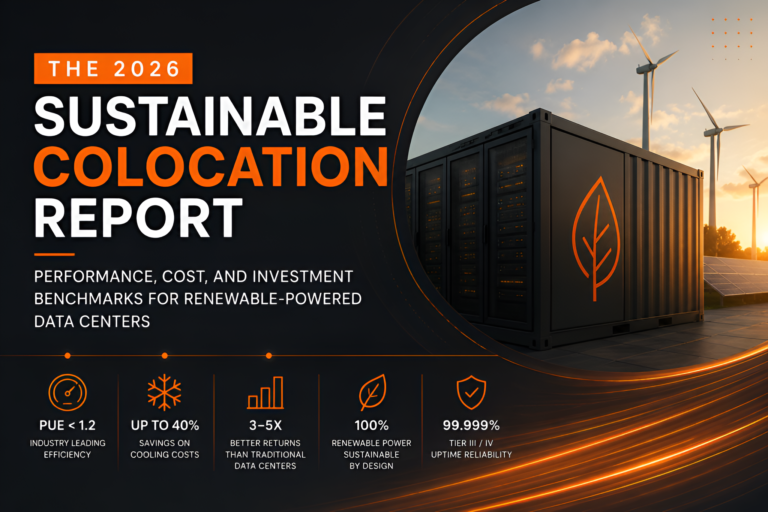
A renewable-powered disaster recovery model earns its keep even when it is not handling an active failover. Flux Core’s sites maintain a Power Usage Effectiveness (PUE) below 1.2, and energy-efficient cooling can cut power use by up to 40% compared with conventional approaches, so the recovery environment operates efficiently during the long stretches between incidents rather than sitting idle as an expensive insurance policy.
Beyond the headline numbers, the model brings a few benefits that are easy to overlook until an organization evaluates recovery providers side by side:
- Geographic redundancy that reduces latency for the regions it serves
- On-demand scalability instead of a fixed capacity ceiling
- Lower energy costs and a smaller carbon footprint than grid-dependent recovery
- Rapid deployment with lower ongoing maintenance costs
- Edge-ready infrastructure for organizations running distributed operations
- Eligibility for renewable energy tax incentives that a conventional recovery build does not qualify for
Carbon reduction is not a separate line item from the uptime and cost benefits. Flux Core supports Scope 1, 2, and 3 emissions monitoring and verified carbon-removal investments, giving organizations with ESG commitments transparent reporting on their recovery infrastructure the same way they report on primary operations. Solar-powered data centers are the primary input, but Flux Core also builds wind-powered data centers, tidal-powered data centers, and biogas-powered data centers, so the renewable input behind a recovery site can match whichever resource performs best at a given location.
Want the energy-efficiency numbers behind this model? See how Flux Core’s sustainable design lowers operating costs.
Industries That Rely on Renewable-Powered Disaster Recovery
Not every organization weighs disaster recovery the same way, but the industries with the least tolerance for downtime tend to share the same underlying requirement: infrastructure that stays powered and compliant through the exact conditions that triggered the failover.
- Healthcare organizations protecting patient systems, where HIPAA-compliant backup and recovery is non-negotiable
- Financial data centers securing real-time operations that cannot absorb latency during a failover
- Government and public sector agencies that need grid-independent resiliency for services communities depend on during emergencies
- SaaS providers scaling multi-region recovery without waiting years on new capacity
- Enterprise organizations pursuing ESG-aligned infrastructure across their entire footprint, recovery included
Healthcare systems illustrate the pattern clearly. Hospitals increasingly need to keep patient data within their own governance framework rather than routed entirely through third-party cloud infrastructure, and on-site, renewable-powered recovery capacity supports that data sovereignty while still meeting HIPAA-aligned compliance and auditable access requirements. Financial institutions face a parallel requirement: real-time operations that cannot tolerate an extended outage, paired with regulatory scrutiny over where and how data is secured.
5 Industries That Depend on Renewable-Powered Disaster Recovery Infrastructure covers all five of these sectors in more detail, including what each one specifically needs from a disaster recovery solutions partner.
Work in a regulated or always-on industry? See how Flux Core’s healthcare data center model supports regulated, always-on operations.
Why Containerized, Renewable Infrastructure Leads Disaster Recovery
Containerized infrastructure solves a problem centralized recovery models were never built to address: the need to site recovery capacity close to where it’s needed, on a timeline that fits an organization’s risk tolerance rather than a multi-year construction schedule. Because each module is manufactured, integrated, and tested before it ships, on-site deployment is largely a placement, power, and network-connection exercise rather than a construction project.
That same portability supports edge-ready recovery for distributed enterprises. A containerized site, as How Edge-Ready Infrastructure Strengthens Disaster Recovery for Distributed Enterprises explains, can sit close to the operations it protects, cutting the latency a failover introduces compared with routing everything through a single centralized facility, while heavier, less time-sensitive recovery tasks still run wherever renewable generation is most abundant. That proximity is also where edge computing solution and disaster recovery reinforce each other for organizations operating across multiple regions.
The containerized model also opens recovery capacity to a different kind of partner. Because modules can be sited wherever renewable energy is available, including on land that would otherwise sit undeveloped, landowners and investors can participate directly in building out regional recovery capacity rather than leaving that opportunity entirely to hyperscale operators. How Containerized Data Centers Let Landowners and Investors Build Disaster Recovery Capacity explains how that partnership model works in practice.
What Should You Evaluate in a Disaster Recovery Infrastructure Partner?
A short list of questions tends to separate a credible disaster recovery solutions partner from one that only looks complete on paper:
- Does the recovery site generate its own power, or does it depend on the same utility grid as the primary facility?
- How quickly can new recovery capacity be deployed in a region where it is currently missing?
- What compliance frameworks, such as HIPAA, ISO, PII, or SOC 2, does the facility support?
- Is redundancy engineered at the power, cooling, and network layer, or claimed only at the compute layer?
- Does the partner support migration from legacy infrastructure without introducing new downtime risk?
Curious how containerized infrastructure compares to a traditional build for your specific environment? Talk to Flux Core about evaluating a disaster recovery infrastructure partner.
Why Flux Core Is a Trusted Disaster Recovery Partner
Flux Core Data Systems & Energy Inc. designs renewable generation and compute as a single integrated system rather than bolting clean power onto a conventional recovery facility after the fact. That design already reaches across a real footprint: California, Texas, Arizona, Nevada, Florida, North Carolina, and Georgia all have sites live today, giving organizations real choices for where to place recovery capacity relative to where their primary operations actually run.
Migrating off legacy infrastructure, a private data center, or a cloud-heavy recovery setup is never risk-free, so Flux Core walks each transition through a structured assessment, planning, and execution process built to keep disruption to a minimum. The goal is straightforward: a recovery migration should never introduce the exact downtime risk the new environment is supposed to remove. Every deployment also pairs continuous monitoring, cybersecurity, and backup redundancy with renewable, low-cost compute, so what a customer gets isn’t just a lower power bill, it’s real operational rigor behind it.
That same engineering discipline, facility-level redundancy, HIPAA- and SOC 2-aligned compliance, a distributed and renewable-powered footprint, is what makes Flux Core a credible disaster recovery partner specifically, not just a data center operator with a backup offering bolted on. Resilience here isn’t a separate product line. It’s the same infrastructure, built from the ground up to keep running when it matters most.
Contact Flux Core Data Systems & Energy Inc. to scope a renewable-powered disaster recovery deployment for your organization.
Frequently Asked Questions
Cloud based disaster recovery replicates an organization’s systems, applications, and data to geographically distributed infrastructure so operations can resume within set RTO and RPO targets if the primary environment fails, using automated failover rather than manual restoration from physical backups.
Because the events that trigger disaster recovery, power failures, storms, and regional disruptions, often affect the same utility territory as the recovery site itself. A recovery site that depends on the public grid can lose power at the exact moment it is needed, which is why Flux Core’s sites run on-site solar and battery generation as a self-sustaining microgrid.
Flux Core’s modular, containerized units reach full operation in as little as 90 days, well inside the 18-to-36-month window a traditional facility build typically requires, because the power, cooling, and networking are integrated and tested before the module ever reaches the site.
Yes. Flux Core operates Tier III and Tier IV-level facilities with 99.999% uptime and supports HIPAA-, ISO-, PII-, and SOC 2-aligned deployments, which covers the compliance and continuity requirements regulated sectors such as healthcare and finance depend on for production failover.
A backup protects the data itself, typically as a point-in-time copy. A full backup disaster recovery solution protects the ability to keep operating, combining data replication with a secondary compute environment and an automated failover process so an organization can resume operations, not just restore files.